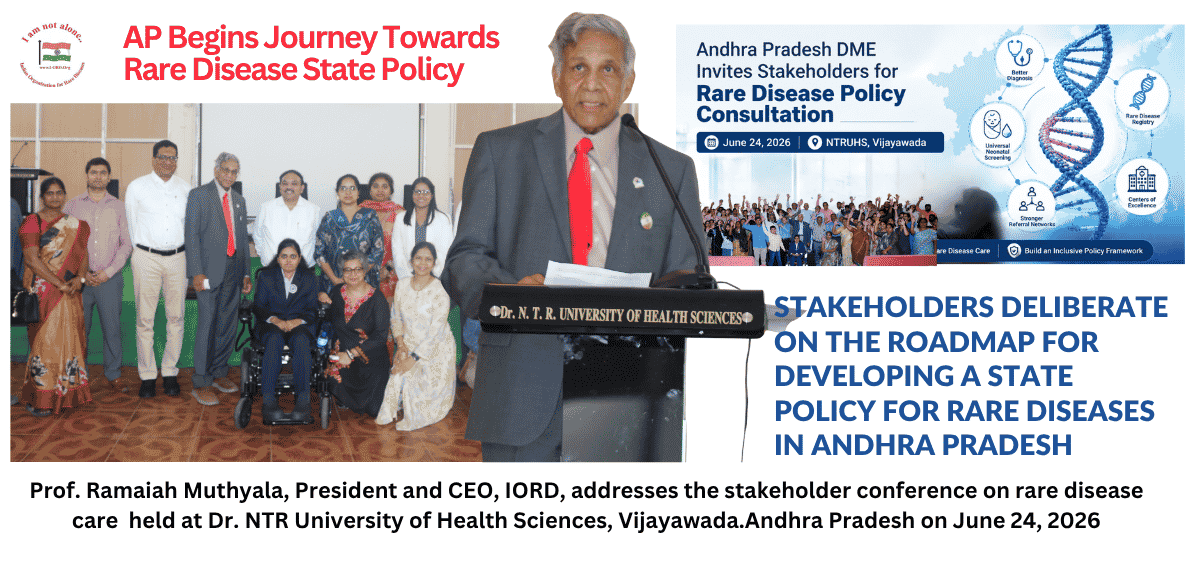
Vijayawada: The Government of Andhra Pradesh has taken a significant step towards strengthening rare disease care by initiating discussions on a State Policy for Rare Diseases through a first-of-its-kind stakeholder conference.
Organised by the Directorate of Medical Education (DME), Government of Andhra Pradesh, the Stakeholder Conference on Rare Disease Care and Draft Policy Consultation in Andhra Pradesh was held at Dr. NTR University of Health Sciences, Vijayawada. The conference was virtually joined by Mr Satya Kumar Yadav, Minister for Health, Medical and Family Welfare, Government of Andhra Pradesh, who reaffirmed the state’s commitment to ensuring that no rare disease patient is deprived of timely treatment or financial support due to lack of access.
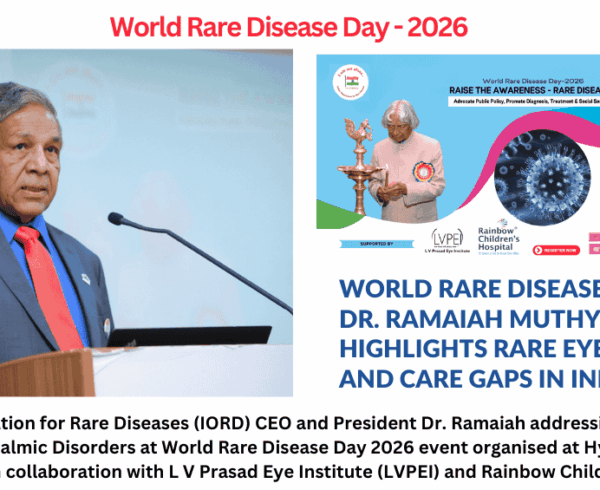
In his address to the participants, Prof. Ramaiah Muthyala, President and CEO, Indian Organisation for Rare Diseases (IORD), described the event as a landmark moment in India’s rare disease journey. He noted that Andhra Pradesh has become the first state in the country to publicly initiate a structured dialogue on developing a state policy for rare diseases, calling it an emotional and historic milestone after years of sustained advocacy.
Prof. Muthyala recalled that IORD was founded in 2005, when rare diseases and orphan drugs received little attention in India. He acknowledged the late President Dr. A.P.J. Abdul Kalam for bringing national attention to this neglected area and highlighted the release of IORD’s landmark White Paper on Rare Diseases in Hyderabad in 2015, which focused on awareness, policy, diagnosis, registries and genetics. He also referred to the subsequent formulation of the National Policy for Rare Diseases and reflected on IORD’s long association with Andhra Pradesh since 2016, including continued engagement with successive state governments to improve rare disease care.
Emphasising that healthcare is a shared responsibility between the Centre and the states, Prof. Muthyala said that while the Union Government provides policy direction, regulations and funding, state governments play the crucial role of implementation and service delivery. Effective coordination between both levels, he said, is essential for translating policy into meaningful care for patients and families.
Addressing the gathering, Sri S. Suresh Kumar, IAS, Principal Secretary, Health, Medical & Family Welfare, Government of Andhra Pradesh, stressed that rare diseases often present with varied and complex symptoms, making early recognition difficult. He highlighted the importance of training doctors, laboratory technicians and frontline healthcare workers to improve timely identification of rare diseases, while also creating awareness among parents so that early warning signs are recognised without delay.
Offering the patient perspective, Sobha Rani Sunkara, Founder and Director, Amaravathi Rare Diseases Organization (ARDO), highlighted the continuing challenges faced by rare disease families in obtaining diagnosis, treatment, rehabilitation and social inclusion. She underscored the need for early diagnosis, timely genetic testing, stronger collaboration among patient organisations, healthcare professionals, researchers, industry and government, and greater public awareness to improve access to affordable diagnostics and therapies. She reaffirmed ARDO’s commitment to supporting families through awareness, education, genetic testing assistance, rehabilitation and policy advocacy.
The conference, chaired by Dr. A. Vishnuvardhan, Director of Medical Education (DME), and Dr. V. Radhika Reddy, Additional Director of Medical Education, brought together a diverse group of experts and stakeholders. Participants included senior officials from the Government of Andhra Pradesh, clinicians, geneticists, neurologists, paediatric specialists, researchers from ICMR, and the IORD team comprising Dr. Krishnaji Rao, Secretary, IORD, and Prabeer Sikdar, Coordinator, IORD. The gathering also included patient organisations such as Niemann Pick India, LSDSS, Bharath MD Foundation, Cure SMA India, Indo US Rare, IORD, and ORDI, along with industry leaders and healthcare partners.