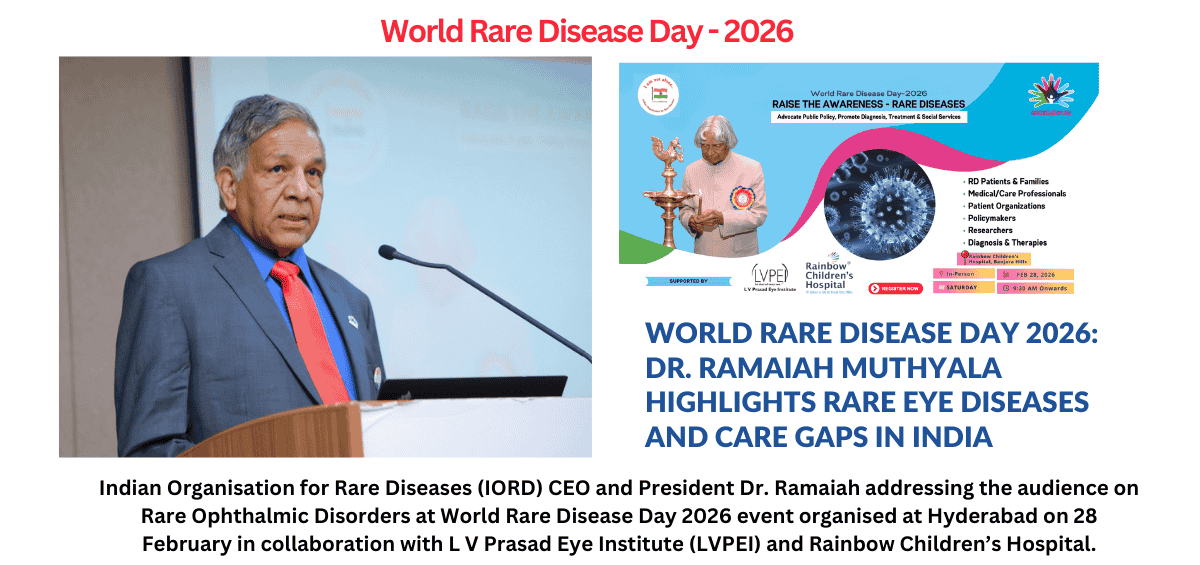
This is a transcribed speech of Indian Organisation for Rare Diseases (IORD) President and CEO, Prof. Ramaiah Muthyala, delivered at the World Rare Disease Day 2026 event in Hyderabad, focusing on rare ophthalmic disorders. Check the full video here.
World Rare Disease Day was launched in 2008 by EURORDIS, and since then, it has been observed in more than 190 countries. Its original intent was to raise awareness of rare diseases through social and public awareness programs. Rare Disease Day is now observed in more than 190 countries.
We at IORD have conducted several such activities for more than a dozen years. Usually, all these events are generalized in the sense that they address patients with different diseases.
As you all know, all diseases are not the same. Patients have different needs, treatments, and outcomes. Therefore, we thought we would observe Rare Disease Day with a specific thematic category, such as cardiovascular disease, neurological disease, endocrine disorders, ophthalmological disorders, dermatological disorders, etc.
What made us think differently?
India is home to a large number of patients with rare diseases due to its large population—a reflection of sheer population volume rather than disproportionate disease frequency. Over the past 20 years, major breakthroughs have been made in diagnosing and treating rare diseases. Because many rare diseases arise from simple, single-gene mutations, they provide clean models for understanding complex biological mechanisms. These mechanisms often form parts of the much more intricate pathways underlying common diseases. Thus, rare diseases represent key “pieces” of the puzzle needed to solve common diseases.
Rare Diseases and Visual Impact
The estimated number of rare diseases is around 7,000, and the ICMR lists 450 rare diseases in India. Interestingly, many of these are associated with visual problems.
For example:
- Patients with spinocerebellar ataxia type 7 (SCA7) experience progressive vision loss.
- Oculocutaneous albinism type 1B (OCA1B) patients have pale skin, white hair, and light-colored eyes and often have visual problems.
- Lysosomal storage disorders, such as MPS II, can cause blindness in children as they become adults.
- Marfan syndrome – lens dislocation, retinal detachment.
- Wilson disease – corneal copper deposits.
- Leber congenital amaurosis – severe early-onset visual impairment or blindness.
According to patient advocacy information, there are roughly 400+ identified rare ophthalmic conditions in India—this is an estimate rather than registry-based prevalence data.
Rare eye diseases and their global burden, disease patterns, and challenges in accurate diagnosis are left to anyone’s imagination.
Focus Area: Oculopathy
This year, we are focusing on oculopathy.
We reviewed various national healthcare facilities and available services for treating rare eye diseases in India. Our analysis found several gaps in the provision of comprehensive care for rare eye conditions.
For example, due to limited awareness among general ophthalmologists and practitioners of rare eye conditions, many hospitals are not equipped to provide comprehensive care. Trained pediatricians, ophthalmologists, and related personnel are unavailable in most eye care centers in India.
Similarly, genetic testing facilities for prenatal diagnosis in cases with a positive family history of genetic disorders, as well as adequate research and development in the management of rare eye conditions, are lacking.
Center of Excellence: LVPEI
In this connection, we would like to highlight the Center of Excellence for Rare Eye Diseases at LVPEI, Hyderabad, India. It is a first-of-its-kind center focused exclusively on advancing eye care and treatment for patients with rare systemic disorders.
It is the brainchild of Dr. Muralidhar Ramappa, who is now the Head of the Center for Rare Eye Diseases and Ocular Genetics at LVPEI. IORD is fortunate to have him as an associate, particularly in the initial stages of the Center for Rare Eye Diseases at LVPEI.
It provides high-quality care at an affordable cost, and at no cost to those who cannot afford it, along with awareness programs and campaigns. This is the hallmark of CERED.
With these initiatives and collaborations, we hope to provide services to patients with rare eye diseases in India and abroad.
Looking Ahead
I am happy to announce, although prematurely, that for Rare Disease Day 2027 we wish to highlight rare cardiovascular disorders.
Our efforts are not just for one day in a year; we continue to strive to achieve our goals.
Ongoing Long-Term Projects
- Policy advocacy
- Newborn screening approval for diseases in the NPRD
- Rare disease registries
- Prevalence counting through ASHA workers
- Diagnostic odyssey
- Orphan drug discovery
- Making generic orphan drugs available
- Natural history of identified common rare diseases
- International collaborations
- Involvement with WHO, UN, etc.
Short-Term Projects
- Incorporation of rare diseases into the medical school curriculum
- Young leader programs
- Educating high school students
- Creating rare disease posters for awareness