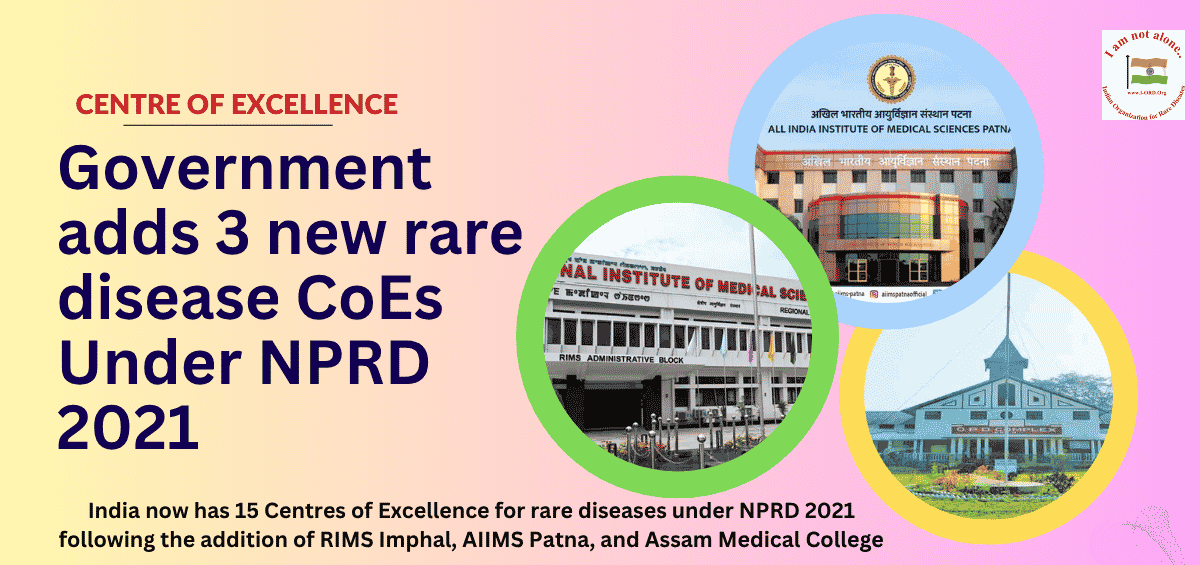
India’s rare disease healthcare infrastructure has expanded to 15 Centres of Excellence (CoEs) under the National Policy for Rare Diseases (NPRD), 2021, with the inclusion of three new government institutions — Regional Institute of Medical Sciences (RIMS), Imphal; AIIMS Patna; and Assam Medical College.
The additions were notified through separate Office Memorandums issued by the Rare Disease Cell under the Ministry of Health and Family Welfare (MoHFW), Government of India. Regional Institute of Medical Sciences (RIMS), Imphal, Manipur, was included as a Centre of Excellence through Office Memorandum No. W.11037/82/2023-RD(Part1) dated 20.01.2025. AIIMS Patna, Bihar, was designated through Office Memorandum No. P-18012/15/2022-EPI/RD dated 07.08.2025, while Assam Medical College & Hospital, Dibrugarh, Assam, was included through Office Memorandum No. Z-15015/37/2024-SAS-II/RD dated 26.08.2025 under the National Policy for Rare Diseases (NPRD), 2021.
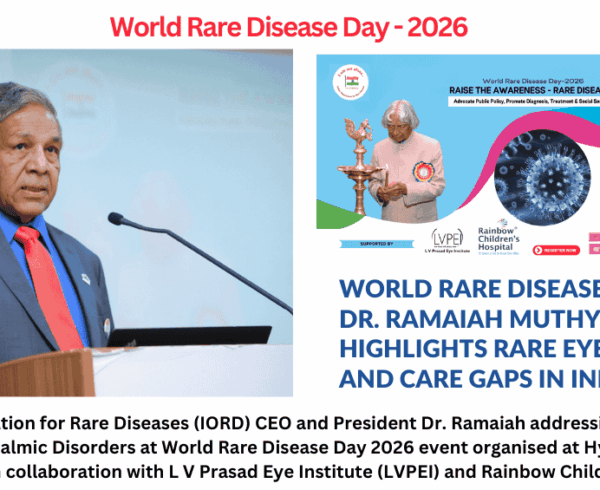
“The establishment of Centers of Excellence (CoEs) under India’s National Policy for Rare Diseases 2021 is a monumental step toward saving lives. Future centers must be selected and evaluated using transparent, outcome-oriented metrics. Furthermore, true patient-centered care demands that patient organizations and caregiver groups be formally integrated into CoE governance, including advisory committees and ethics boards. They are the true stakeholders; their voices ensure transparency and accountability,” said Prof Ramaiah Muthyala, President and CEO, Indian Organisation for Rare Diseases.
The newly added CoEs are expected to strengthen regional access to specialised diagnosis, screening, genetic counselling, and treatment services for rare disease patients across eastern and northeastern India. The notifications came into effect from the date of issuance and were approved by the competent authority. The Office Memorandums were circulated to various ministries, departments, state governments, existing CoEs, and nodal officers involved in rare disease policy implementation.
It is significant to note that the expansion of CoEs comes at a time when the Government of India is steadily increasing financial support and infrastructure under the NPRD, 2021.
In a Lok Sabha reply tabled on February 6, 2026, Minister of State for Health and Family Welfare Shri Prataprao Jadhav informed that the number of CoEs under NPRD 2021 has increased from 8 to 15 since the policy’s inception. The government stated that approximately ₹264 crore had been allocated to CoEs from FY 2021–22 till March 2025, while around ₹61.84 crore has been budgeted for FY 2025–26. The reply also noted that utilisation certificates from 11 CoEs are still awaited under General Financial Rules (GFR), and the Ministry is periodically reviewing fund utilisation and implementation under the policy.
“India’s expansion of Rare Disease Centres of Excellence under NPRD 2021 is a progressive and highly encouraging development for patients and families across the country. However, addressing the under-utilisation of allocated funds at certain Centres of Excellence is equally important to ensure that the intended benefits of diagnosis, treatment, research, and patient support reach eligible individuals in a timely manner,” Dr. Krishnaji Rao, Secretary, Indian Organisation for Rare Diseases.
Responsibilities of Rare Disease Centres of Excellence
Under Para 9.2 of the National Policy for Rare Diseases (NPRD), 2021, the Centre of Excellence discharges the following responsibilities and activities:
- Education & Training at all levels
- Screening – Antenatal, neonatal (specified disorders), High-risk screening (Both antenatal & in newborns and children)
- Diagnostics- Cytogenetic, molecular, Metabolic
- Prevention by prenatal screening & diagnosis
- Research in the area of low-cost diagnostics & therapeutics.
List of Rare Disease Centres of Excellence in India
Here are the 15 designated CoEs treating rare diseases in the country. These CoEs have dedicated rare disease committees:
- All India Institute of Medical Sciences, New Delhi
- Maulana Azad Medical College (MAMC), New Delhi
- Sanjay Gandhi Postgraduate Institute of Medical Sciences, Lucknow, Uttar Pradesh
- Postgraduate Institute of Medical Education and Research(PGIMER), Chandigarh, Punjab/Haryana
- Center for DNA Fingerprinting & Diagnostics, Hyderabad, Telangana
- King Edward (VII) Memorial Hospitaland Seth Gordhandas Sunderdas Medical College, Mumbai, Maharashtra
- Institute of Post Graduate Medical Education and Research, Calcutta, West Bengal
- Centre for Human Genetics(CHG), Bangalore, Karnataka
- All India Institute of Medical Sciences, Jodhpur, Rajasthan
- Institute of Child Health, Egmore, Chennai, Tamil Nadu
- Sree Avittam Thirunal Hospital (SAT),Thiruvananthapuram, Kerala
- All India Institute of Medical Sciences (AIIMS), Bhopal, Madhya Pradesh
- Regional Institute of Medical Sciences (RIMS), Imphal, Manipur
- AIIMS Patna, Bihar
- Assam Medical College, Assam
Nidan Kendras for Genetic Testing and Counselling
Besides the 12 CoEs, the Department of Biotechnology (DBT) has established 5 Nidan Kendras under the Unique Methods of Management and treatment of Inherited Disorders (UMMID) project for genetic testing and counseling of rare diseases. These centers offer screening, genetic testing, and counseling services.
They include:
Lady Hardinge Medical College (LHMC), Delhi
Nizam’s Institute of Medical Sciences (NIMS), Hyderabad, Telangana
All India Institute of Medical Sciences (AIIMS), Jodhpur
Army Hospital Research & Referral, Delhi
Nil Ratan Sircar (NRS) Medical College and Hospital, Kolkata
Our CoEs must participate in international registries, joint clinical trials, and pioneering research in gene therapy and precision medicine — Prof Ramaiah Muthyala, President & CEO, IORD



Leave a Comment