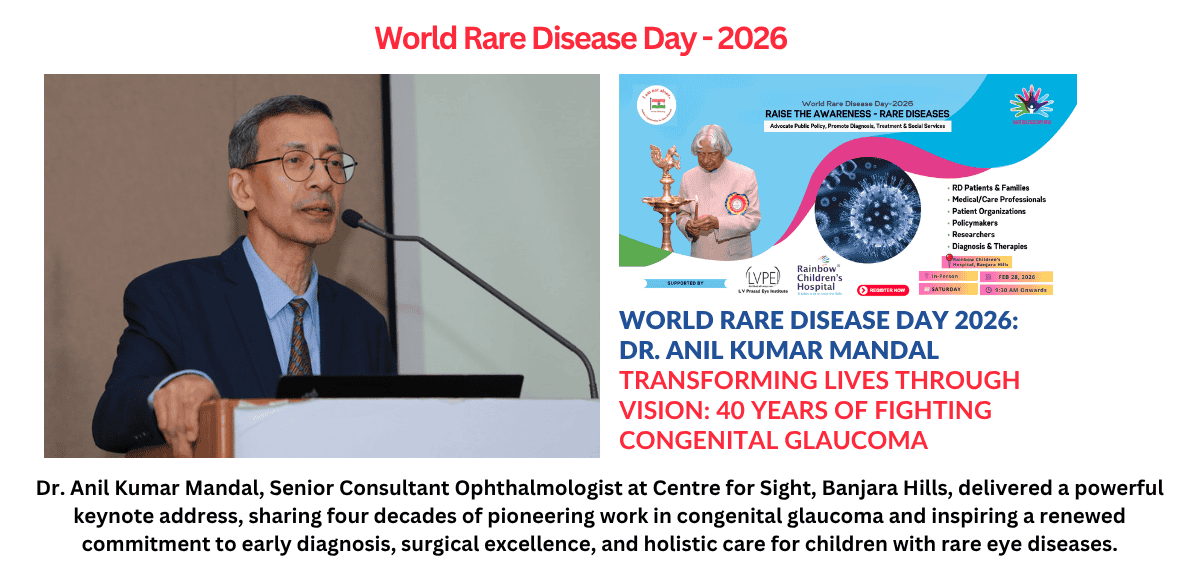
This is a transcribed keynote address by Dr. Anil Kumar Mandal, Senior Consultant Ophthalmologist at Centre for Sight, Banjara Hills, delivered at the Indian Organisation for Rare Diseases (IORD) World Rare Disease Day 2026 event in Hyderabad, focusing on rare ophthalmic disorders. Check the video here.
For a specific cause—creating awareness about rare disease – this year’s theme is ophthalmology.
Friends, I, as an eye specialist, have been working on rare diseases for about the last 40 years, of which the first 6 years were my training at All India Institute of Medical Sciences. My interest in rare diseases of congenital glaucoma lie two things: one institute and one individual. The institute is the All-India Institute of Medical Sciences, Department of Ophthalmology, Dr. Rajendra Prasad Centre for Ophthalmic Sciences, and my mentor, Professor N. N. Sood.
You know, behind this interest in rare disease of congenital glaucoma lie two things: one institute and an individual. The institute is the All-India Institute of Medical Sciences, Department of Ophthalmology, Dr. Rajendra Prasad Centre for Ophthalmic Sciences, and my mentor Professor N. N. Sood. I have a 3-minute video for Professor Sood, and that I will present at the end of my presentation.
What I’ll do in my brief presentation is give a broad overview of my work, my learning, and my work over the last 40 years. Primary congenital glaucoma is a rare disease—so rare that it is said an average ophthalmologist may see a case of newborn glaucoma or congenital glaucoma once in 5 years of practice. A general practitioner may see a case in his lifetime.
If we go into the literature in western countries, the disease is prevalent at one in 10,000 to one in 30,000 live births. But in a population-based study conducted by L. V. Prasad Eye Institute, we realized that the disease is much more prevalent in the southern part of India—1 in 3300 live births. That is 8 to 10 times more common than the western counterpart. And it is responsible for 4.2% of blindness in India.
A healthy child—if the child appears healthy—the family, the parents expect a healthy child. But look at the situation: if the child is born with this condition, the scenario changes dramatically. There are few things as devastating to the parents as the knowledge that they have produced a child with developmental glaucoma. All the hopes for perpetuation and fulfillment of their own lives are shattered, and they inevitably follow the nagging sense of guilt that in some way they have been punished. Family tension mounts as they focus blame on each other, and the unconscious desire to reject the child is in constant conflict with the certain knowledge that it is their responsibility to love him and to accept him.
Blindness is becoming a social problem, suddenly impinging on the conscience even of the developing world. We are aware that more than half of the children now blind did not have to lose their sight or could have had their visual disabilities corrected. Society can no longer ease its concern by offering the old means of income nor by the more modern methods of pension and relief. Even if a child is incurably blind, he or she still has equal social rights and economic possibilities that must be realized and fulfilled.
This calls for clarification of many aspects of blindness and the determination of the measure of society’s responsibility for this segment of the world’s population which lives under the handicap of visual impairment. If the tears of this little child move you, they are a window open onto the sea. For what you feel are not merely the tears of this one child, but of all children.
I dreamt that I could dedicate my life to caring for these children and started working on this disease independently only after joining L. V. Prasad Institute in the year 1990—to be very specific, 22nd August 1990. I’d like to share my experiences with you. The more we share, the more we have in these cases—so true.
As late as 1939, Anderson saw little hope of useful vision in children, despite detailed evaluation of all known treatment modalities available at that time. He quoted Schifferl in saying that, “I know of no case of operated hydrophthalmia where undiminished sight has been retained in later life.” Anderson, in his textbook, further wrote: “The future of children with hydrophthalmia is weak, little hope to preserve vision sufficient to permit earning a livelihood that can be held out today. It progresses as a rule in a relentless fashion until the best setting for the patient is some institution that caters to the client.”
But this very prognosis of congenital glaucoma has changed dramatically. We wanted this new philosophy about developmental glaucoma: early diagnosis and prompt microsurgical intervention.
The picture you see here—the child was brought to us at L. V. Prasad Eye Institute in the year 1993, and the father was an optometrist actually. In spite of my explanation that it was a minor form of the disease and the child should be okay, there was failure on my part. I could not elicit a smile on the parents’ faces. I requested them to capture that moment, and I told them that after 2 months, after the operation, the child will see and will smile automatically. I don’t have to provoke.
The same thing happened—2 months post-operative, the child’s parents came with smiling faces. I followed up this child, now a lady, for about 35 years, and here is the 25-year picture. I’ll come to the other part of the story later. I happened to be in the family of this girl, and it was a nice feeling.
Now, the picture is like this: it is primarily a surgical disease. Medical therapy has afforded only a supporting role, and the surgery should be performed as early as possible. In my lifetime, I have operated on more than 5000 children, of which several were operated within a week. This is a child who was operated on at 3 days of birth.
Before 1938, there was no surgery described. The invariable outcome was blindness. Several surgical techniques came. The first technique was described by Otto Barkan in the year 1938. After that, several improvements happened, and the prognosis improved. In the year 2022, we published an improved surgical technique in my name.
So here are the dignitaries who have contributed so much to congenital glaucoma management. The lower picture—my mentor Professor N. N. Sood—from whom I learned the science and art of taking care of children with congenital glaucoma. His invention, a path-breaking surgical technique—primary combined trabeculotomy—is the way to go. Several of his students and fellows are now doing this technique, and it has been the most appropriate for most patients we see in India.
Here is a child brought to us at the age of 3 months. You can see the left eye afflicted with sudden corneal clouding—infantile onset glaucoma—an emergency situation. We operated on the child, and the next picture shows the cornea cleared, and the child is doing very well. This is a story from 2011, and I am still following up the child. The child is studying in 10th standard.
Catching my gaze with limpid eyes, in his mother’s arms he refuses to see. With appealing eyes, he speaks the language of his soul. The face lit up with smiles, a radiant beam on the baby’s face.
So, we published several reports on primary surgery. When primary surgery fails, second surgery is done. Some patients require multiple surgical interventions—not just glaucoma surgery, sometimes penetrating keratoplasty. With Dr. Muralidhar, we have done several hundred patients undergoing keratoplasty after normalization of intraocular pressure following glaucoma surgery.
For the first time in 1990, the textbook mentioned our work and surgical technique. I’m not going into details, but in the first 21 years, we operated on 1128 eyes of 653 children, and results were satisfactory. In the recent 13 years (2011–2023), 704 children and 1150 eyes. Taken together, these two papers form the world’s largest series on congenital glaucoma.
One-third of patients have good vision, 16% fair vision, and a significant percentage—almost one-third to one-half—require some form of visual rehabilitation.
Over the years, we developed an integrated approach for holistic care—medical, surgical, genetic, and rehabilitation. First aim: restore corneal clarity. Next: improve visual function. Final goal: maximize quality of life.
A significant percentage of patients may have visual impairment or blindness. Even if we cannot help the eye, we must help the child. Rehabilitation must be provided. It is no longer acceptable for an ophthalmologist to abandon a child after treatment.
There are several questions of social concern. Social concern for the problems of blindness and its alleviation cannot ease only with full understanding of the medical aspects and the possibilities of cures and prevention, but should seek to culminate in the rehabilitation of the children involved and aim at their integration into society as contributing members.
While workers for the blind need to understand more fully the medical aspects of their rehabilitation clients, many medical professionals must come to know and accept the economic possibilities of blind children. But with the progress that has already been made, it may not be too much to hope that medical research combined with physical rehabilitation and social acceptance will bring fulfillment of the words of the Old Testament: “I will bring the blind by a way they knew not. I will lead them in paths which they have not known. I will make darkness light before them and crooked places straight. These things will I do and not forsake them.”
In the best scenario, several of my operated children are now in medicine. Sixteen are doctors, of which eight are postgraduate doctors. Some are doing medicine, and some entered medicine in the last year. Several others are in professions like teacher, engineer, lawyer, computer science, cyber security, journalist, and chartered accountant, etc.
Here is a child who was operated on at the age of 1 month. The child did medicine, completed MBBS from West Bengal University, and is now working as a medical officer in Hyderabad.
Several other children have done dentistry, internal medicine, surgery, dermatology, psychiatry, etc. In the last year, four of my operated children entered medicine. Here you see a child operated on at the age of one week—first-year MBBS. Again, another child in first-year MBBS. The younger sister of the previous child is doing second-year MBBS in Lady Hardinge Medical College.
This is the best-case scenario. At the other end of the spectrum, there are some children who are totally blind or have severe visual impairment. The child you see here—the son and daughter of a couple—both had congenital glaucoma and underwent multiple surgeries. The boy, when I saw him at the age of 8 years, had no perception of light in both eyes—totally blind. The younger sister had some vision; she continued medicine and has now completed graduation and is working.
We explained the situation to the parents and referred them to our rehabilitation department. Daily living tasks, computer training, etc., were taught. This child did industrial engineering from Dubai. After that, he competed with normally sighted peers and became the topper in his batch. He did one year of industrial engineering training in London and is now working at Barclays Bank.
I had an opportunity to speak on this subject in London at a UK pediatric society meeting in 2019. I requested the organizers to call him, as he was in London. He came and spoke about his life, how he coped with the situation, and how he is leading a fruitful life.
Here is the person—a UK national champion in blind tennis (2021 and 2022) and world number one tennis champion in the blind category in Birmingham in 2023. With permission from the family, I share that he is married to a medical student, now a doctor, and they are settled in the UK.
Another example: a child I saw with one eye already lost and limited vision in the other. We operated to control eye pressure and later performed keratoplasty. However, during a crowded event, the only seeing eye was injured, and vision was completely lost. Despite all efforts, we could not restore vision.
Even then, he continued life. He learned swimming, cycling, and running. He competed in a triathlon in Dubai and became the first Ironman in the blind category. I have followed him since age 2; now he is over 40. He runs a masala business employing about 25 people. He once told me, “Doctor, life has become so busy that sometimes I forget that I am blind.” He is married and has a child studying further.
So these are the two extremes—one with excellent vision and one with none—and many patients lie in between.
Here is another example: a child operated on at 2 weeks of age, now doing well, working, with 27 years of follow-up. Another case with 31 years of follow-up—now married with children.
I also followed patients of my mentor from AIIMS. One such child from Hyderabad was treated at 6 months and is now a parent with two healthy children after 38 years of follow-up. Another from Aurangabad, operated at 6 months, completed MBA and is managing her father’s business—37 years of follow-up.
These patients inspired me to focus on this rare disease during my fellowship.
We have trained professionals for 35 years at L. V. Prasad Eye Institute and continue now at Centre for Sight, transferring microsurgical skills to the next generation. Our aim is to create capable professionals who will carry forward this work.
We also created a parent support group to raise awareness.
Our contribution includes holistic care and innovation, including new surgical techniques.
A bibliographic analysis of global literature (1955–2022) showed L. V. Prasad Institute at the top, and I humbly acknowledge that my name appeared among the top contributors. This is not individual work but team effort.
Creating awareness is perhaps the most important investment. Children are not just the future—they are also the present.
Children are our greatest insurance for the present and hope for the future. Our worst crime is neglecting them. Many things can wait; the child cannot. His name is today.
Unless we care for children, our future is in jeopardy. We must provide every opportunity for development, including vision care and rehabilitation.
When judging blindness, we must consider not just numbers but the years of life affected. Even if vision cannot be restored, rehabilitation must be ensured so that every child becomes a contributing member of society.
This integrated approach improves quality of life for children and their families.
Here is a child I operated on during my third year of MBBS. He is now studying medicine and wants to become an ophthalmologist and treat children with glaucoma.
The child I mentioned earlier is now married with children and doing well.
We are fortunate to be in Hyderabad and at L. V. Prasad Institute, where Dr. Rao created a culture of excellence—excellence being a journey, not a destination.
I express my gratitude to all healthcare team members—faculty, fellows, residents, nurses, anesthetists, pediatricians, and support staff. This is teamwork.
Lastly, I express heartfelt gratitude to Professor N. N. Sood—an excellent teacher, surgeon, and mentor. I owe my professional skills to him.
I believe surgeons are made, not born. Skill comes from training and experience. Learning is incomplete unless passed on to the next generation.
Our aim is to train “3H ophthalmologists”—Hands, Head, and Heart. Skilled hands, sound judgment, and compassionate care.
Surgical style reflects personality and training—dexterity and gentleness are key.
I remain grateful to Professor Sood for his guidance and opportunities.
My salutation to my Guru.
We must transfer knowledge, attitude, and philosophy to the next generation so that all may see—every eye deserves the best.
In my presentation, I said “I,” but it should be “we.” It is teamwork. When “I” becomes “we,” illness becomes wellness.
I conclude with lines from Tagore:
“O Lord, let my head bow down at your feet. Let my pride dissolve in tears. Let my work fulfill your will.”
Thank you.