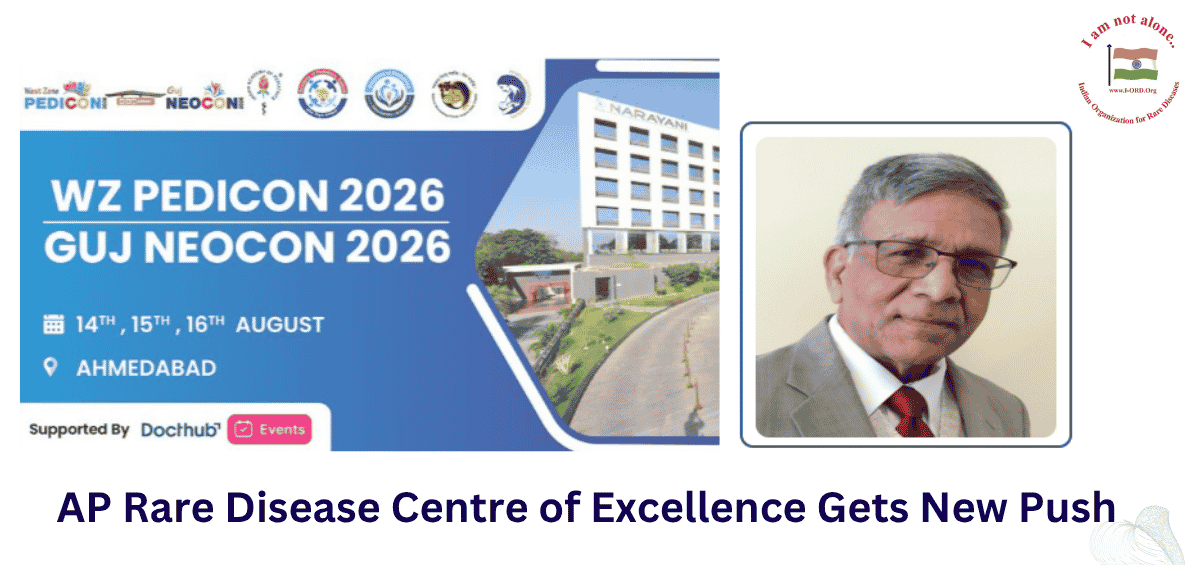
Ahmedabad (Gujarat): Andhra Pradesh needs to move from a policy commitment to a physical Centre of Excellence for rare diseases, with an integrated system designed to bring diagnosis, treatment, research and patient support under one coordinated network, said Prof. Ramaiah Muthyala, President and CEO, Indian Organization for Rare Diseases (IORD), at WZPEDICON-GUJNEOCON Conference-2026 held in Ahmedabad, Gujarat.
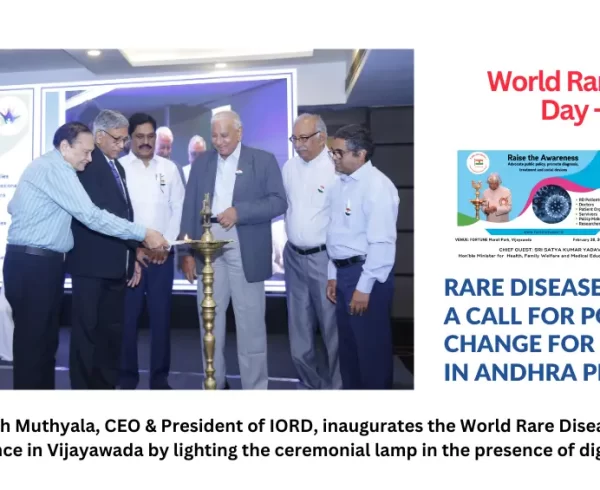
Speaking about the evolution of Rare Disease Centres of Excellence in India, Prof. Muthyala cited IORD’s collaborative work with the Andhra Pradesh Government as an example of the efforts towards establishing a Rare Disease Centre of Excellence at the state level. IORD and the Andhra Pradesh Government signed an MoU on February 28, 2025, with the objective of bridging the gap between state health policy and rare disease patient care and defining the respective roles in establishing a Centre of Excellence.
In his presentation, “Rare Disease Center of Excellence: Addressing the Missing Link — Establishment in India and the Strategic Role of IORD,” delivered at the 8th West Zone Pediatric & 23rd Gujarat Neonatology Conference in Ahmedabad from August 14 to 16, Prof. Muthyala outlined the lessons from existing CoEs and the principles that could guide a new centre in Andhra Pradesh.
“A CoE will not succeed through funding or infrastructure alone. It is the synthesis of three pieces: Central Policy, State Infrastructure, and NGO Expertise. When these three elements interlock, they create a sustainable, resilient rare disease ecosystem,” Prof. Muthyala said.
Rather than simply adding another specialized unit to an existing hospital system, he proposed a “greenfield” approach—designing integrated clinical, diagnostic, digital, research and patient-support systems from the outset.
The scale of the challenge makes such a system-level approach particularly important. The presentation noted that only 684 patients are currently registered in the ICMR Rare Disease Registry in Andhra Pradesh, placing the state seventh nationally, while the estimated number of people living with rare diseases in the state is 2.68 million, based on global prevalence rates. The wide gap between registered patients and the estimated burden points to a much larger unmet need that existing systems may not be capturing.
Learning from five years of Centres of Excellence
Prof. Muthyala traced the evolution of India’s rare disease policy to IORD’s 2015 white paper, “A Journey Together: Rare Diseases and Orphan Products – India,” unveiled on Rare Disease Day 2015. Development of a national rare disease policy was among its recommendations.
The Centre of Excellence concept emerged in subsequent policy drafts and was expanded under the National Policy for Rare Diseases (NPRD) 2021, which also incorporated funding provisions. The expansion of the CoE network, however, has not been uniform across the country. Even with the expanded list of 15 Centres of Excellence, several major states—including Gujarat, Andhra Pradesh, Odisha, Chhattisgarh, Jharkhand and Uttarakhand—remain without a dedicated Centre of Excellence for rare diseases.
With CoEs now having several years of experience, Prof. Muthyala called for their successes and shortcomings to inform the next generation of centres. The presentation identified problems associated with fragmented clinical services, delayed referrals, inadequate diagnostic infrastructure, workforce gaps, treatment discontinuity and weak data systems.
Instead of replicating legacy systems, the proposed AP centre would adapt practices demonstrated by leading rare disease centres, including multidisciplinary teams, centralized coordination, patient navigators, integrated laboratory and clinical services, referral networks, standardized clinical pathways, quality improvement, patient advocacy and international collaboration.
Designing the system from the ground up
The presentation organized the model around eight strategic priorities spanning clinical care, support and human resources, and digital infrastructure and scale. A key objective is to shorten the diagnostic odyssey—from years to weeks—through early clinician education, rapid genetic testing and coordinated genomic review.
The CoE would also generate real-world clinical data, patient advocacy inputs and localized orphan-product economics that could contribute to evidence-based development of national rare disease policy.
Why Andhra Pradesh?
The proposed centre is intended to function as a statewide multidisciplinary network rather than an isolated hospital wing. Under the NPRD 2021 framework, its architecture would encompass screening, advanced diagnostics, comprehensive treatment, education and research, while connecting a nodal tertiary institution with district facilities, primary care, screening laboratories and specialized rehabilitation services.
The presentation highlighted the geographical burden faced by patients who currently depend heavily on NIMS Hyderabad for CoE-level services. Long-distance and inter-state travel can contribute to fragmented care and diagnostic delays. The proposed model would use telemedicine and partnerships with district hospitals to extend specialized expertise beyond the physical centre.
Building people, supporting families and driving research
Infrastructure alone, Prof. Muthyala emphasized, would not make the centre sustainable. The proposed workforce-development pipeline includes clinician education, specialized nursing and allied-health training, fellowship programmes and advanced subspecialty training.
The patient and family would remain at the centre of care, supported through genetic counselling, psychosocial services, financial guidance and patient advocacy.
Research would form another core component, with biobanks, translational research, clinical trials and national and international collaborations integrated into the ecosystem. The CoE would also operate as a self-improving system, continuously tracking indicators such as time to diagnosis, treatment initiation, patient satisfaction and survival, and using the findings to refine care pathways.
From MoU to action
The immediate roadmap presented for Andhra Pradesh includes constituting a state-level task force, nominating key representatives, conducting a rapid gap analysis of infrastructure, manpower and equipment, and preparing a proposal for submission to the Government of India.
The presentation also highlighted the ₹5 crore one-time institutional grant available under the NPRD framework for targeted infrastructure and equipment, along with patient support provisions and opportunities for registry integration and research collaboration.
A CoE will not succeed through funding or infrastructure alone. It is the synthesis of three pieces: Central Policy, State Infrastructure, and NGO Expertise. When these three elements interlock, they create a sustainable, resilient rare disease ecosystem. — Prof. Ramaiah Muthyala, President and CEO, Indian Organization for Rare Diseases