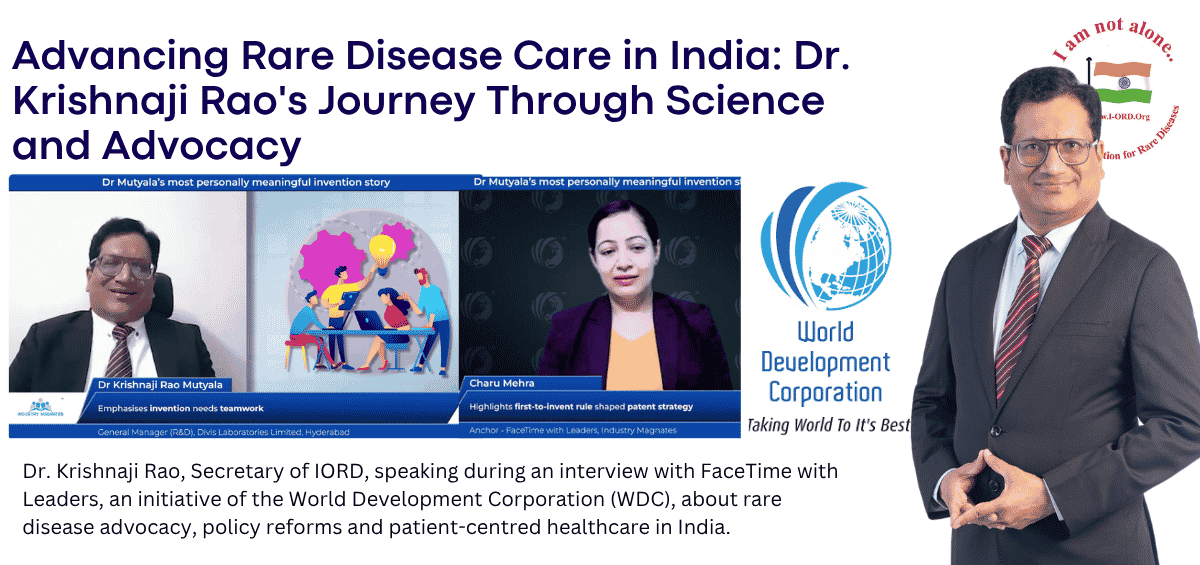
The following is an excerpt from World Development Corporation Industry Magnates interview featuring Dr. Krishnaji Rao, Secretary of the Indian Organisation for Rare Diseases (IORD), on FaceTime with Leaders.
Hyderabad: Earlier diagnosis, wider access to affordable orphan drugs and greater emphasis on medical genetics are essential if India is to improve care for people living with rare diseases, according to Dr. Krishnaji Rao, Secretary of the Indian Organisation for Rare Diseases (IORD).
Speaking in an interview with FaceTime with Leaders, an initiative of the World Development Corporation (WDC), Dr. Rao reflected on how one patient’s struggle with delayed diagnosis inspired years of advocacy through IORD, contributing to policy discussions, awareness and access to care
From One Patient to a National Cause
Although Dr. Krishnaji Rao has spent nearly three decades in pharmaceutical research and innovation, he considers his encounter with a 21-year-old woman diagnosed with muscular dystrophy in 2009 as the turning point in his life. The patient, from a rural village in Andhra Pradesh, experienced a significant delay in diagnosis before her condition was finally confirmed at Nizam’s Institute of Medical Sciences (NIMS).
The experience exposed critical gaps in rare disease awareness and medical genetics education in India. According to Dr. Rao, delayed diagnosis remains one of the biggest challenges faced by people living with rare diseases, reinforcing the need to strengthen genetics education in medical curricula and encourage clinicians to learn from patient narratives while improving diagnosis and treatment pathways.
Strengthening India’s Rare Disease Movement
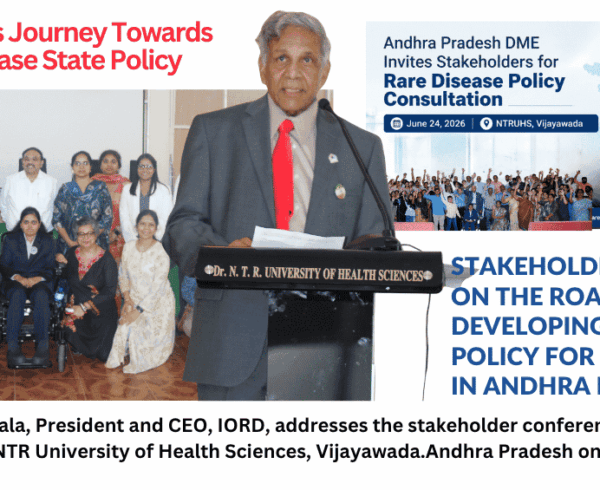
Recognising that meaningful policy change required collective action, Dr. Krishnaji Rao joined Professor Ramaiah Muthyala, President & CEO of the Indian Organisation for Rare Diseases (IORD), and other like-minded experts in strengthening the organisation’s advocacy efforts. Over the years, IORD has brought together patients, clinicians, researchers, policymakers and industry leaders to push for greater recognition of rare diseases within India’s healthcare system.
Under the leadership of Professor Ramaiah Muthyala, IORD published the landmark 16-page White Paper, A Journey Together: Rare Diseases and Orphan Products in India, in March 2015. Released by former President Dr. A.P.J. Abdul Kalam, the document became one of the important advocacy milestones that helped shape India’s National Policy for Rare Diseases (2021). As Secretary of IORD, Dr. Krishnaji Rao contributed to these sustained advocacy efforts while supporting policy discussions on rare diseases and orphan drugs.
During the interview, Dr. Rao also recalled the encouragement received from Dr. Kalam, whose support strengthened the organisation’s efforts to bring rare diseases into national policy discussions. He described rare diseases as an “unfinished agenda” that continues to demand sustained commitment from government, healthcare professionals, researchers, industry and patient organisations.
Advocating Beyond Policy
Over the years, Dr. Krishnaji Rao’s advocacy has extended beyond policy discussions. As Secretary of IORD, he has supported initiatives aimed at improving awareness of rare diseases, promoting access to affordable orphan drugs and encouraging greater collaboration between the Ministries of Health, Commerce and Science. He also highlighted the importance of integrating patient experiences into policymaking, noting that patient stories often provide valuable insights for improving diagnosis and developing practical solutions.
Reflecting on the global landscape, he pointed out that while nearly 8,000 rare diseases have been identified, only a small fraction currently have approved therapies. He believes India must continue investing in awareness, research, local manufacturing and education to improve access to treatment for people living with rare diseases.
Science in Service of Society
Alongside his advocacy work, Dr. Krishnaji Rao has built a distinguished career in the pharmaceutical industry. As General Manager (R&D) at Divis Laboratories Limited, he has led research in active pharmaceutical ingredients (APIs), intellectual property strategy, regulatory compliance and sustainable manufacturing. His work has resulted in multiple patents across India, Europe and the United States, while his research has contributed to affordable pharmaceutical manufacturing and process innovation.
He has also authored more than 22 scientific publications, mentored doctoral scholars and served in several academic leadership positions, consistently advocating stronger collaboration between industry and academia to translate scientific research into healthcare solutions. For him, innovation must ultimately improve patient access and affordability rather than remain confined to laboratories.
The Journey Continues
For thousands of families affected by rare diseases, policy reforms are meaningful only when they translate into earlier diagnosis, affordable treatment and equitable access to care. Dr. Krishnaji Rao believes science, policy, industry and patient experiences must work together to make that possible.
While acknowledging the progress made over the past decade, he describes India’s rare disease journey as far from complete—one that will continue to require collaboration between patients, clinicians, researchers, industry and government, while ensuring that patient narratives remain at the heart of better diagnosis, innovation and policymaking.
Check the full interview here.