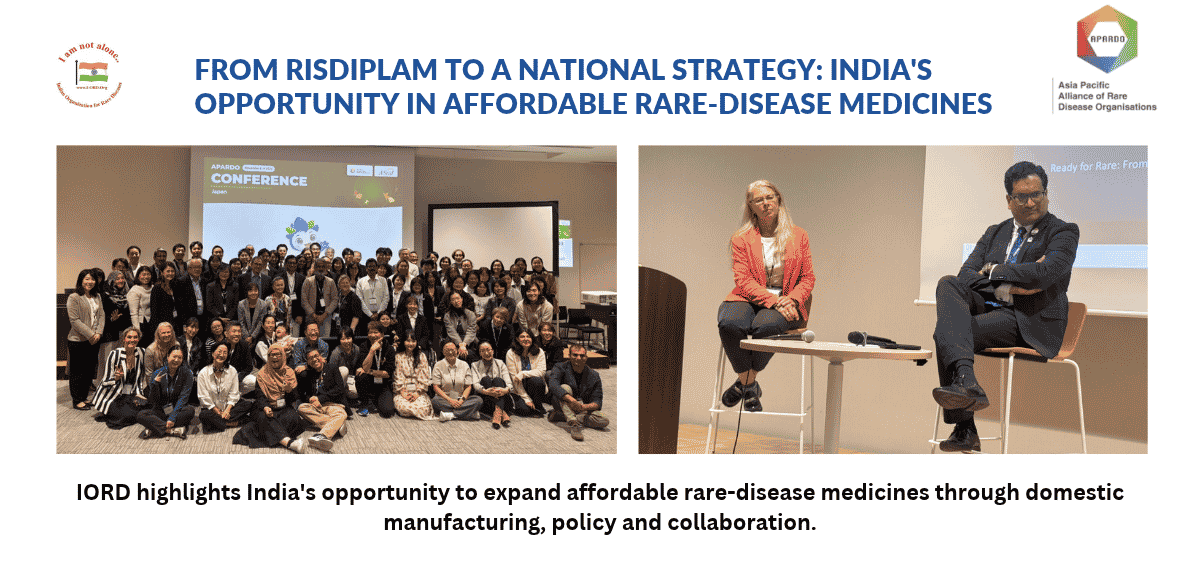
Tokyo, Japan: India’s success in making generic risdiplam available at a substantially lower cost could provide a blueprint for developing affordable medicines for other rare diseases.
The opportunity to replicate this achievement through indigenous pharmaceutical manufacturing, policy interventions and collaborative procurement was among the key issues highlighted by the Indian Organisation for Rare Diseases (IORD) at the APARDO Conference 2026, held at Haneda Innovation City, Tokyo, Japan from 6–8 November.
“Affordability is not merely about reducing the price of a medicine. It is about creating a sustainable healthcare ecosystem in which innovation, manufacturing, intellectual property protection and patient access coexist,” said Dr. M. Krishnaji Rao Mutyala, Governing Secretary, Indian Organisation for Rare Diseases (IORD), while participating in the panel discussion titled “Policy-to-Pathway Example 2: India – One National Policy, Different State Pathways” on 7 November. The session was moderated by Monica Ferrie of APARDO.
As part of its conference preparation, the Asia Pacific Alliance of Rare Disease Organisations (APARDO) developed a baseline knowledge document drawing on published sources and framed five questions for discussion. One focused on the success of risdiplam in India, while the remaining four were addressed through inputs shared by IORD during the conference discussions.
Risdiplam: A model worth replicating
The risdiplam experience offered an important example of how domestic pharmaceutical capabilities can improve access to expensive rare-disease treatments.
Following the Delhi High Court’s decision allowing NATCO Pharma to market its generic risdiplam formulation, Natsmart, the medicine became available at a significantly reduced price compared with the imported version. In March 2026, the Union Ministry of Health & Family Welfare highlighted the domestic manufacturing of risdiplam API under the pharmaceutical Production Linked Incentive (PLI) scheme.
The development demonstrated India’s potential to move beyond dependence on imported orphan medicines and strengthen domestic manufacturing. The larger question raised at APARDO was whether this success could be extended to other high-cost rare-disease treatments.
A memorable meeting between IORD CEO and President Dr. Ramaiah Muthyala and NATCO CEO Rajeev Nannapaneni, united by a shared commitment to healthcare and rare disease advocacy.
What India needs to do next
The discussions highlighted five areas for consideration:
- Identify priority medicines: Develop a national list of high-cost orphan drugs suitable for generic manufacturing, biosimilar development or drug repurposing.
- Strengthen domestic capabilities: Encourage pharmaceutical companies, biotechnology enterprises and research institutions to collaborate on indigenous API and formulation development.
- Leverage existing patent provisions: Apply the safeguards and provisions of the Indian Patents Act, including Sections 3(d), 83 and 84, wherever relevant, to balance innovation with public health interests.
- Introduce pooled procurement: Explore demand aggregation and negotiated pricing to improve affordability, drawing on India’s experience with tuberculosis and HIV programmes.
- Ensure continuity of treatment: Establish sustainable financing and reliable supply mechanisms, particularly for patients requiring lifelong therapies.
IORD’s role in taking the agenda forward
The conference discussions also identified opportunities for IORD to facilitate engagement among patient organisations, policymakers, pharmaceutical manufacturers, researchers and international partners.
Potential areas include promoting affordable orphan drug development, exploring indigenous manufacturing partnerships, advocating pooled procurement and strengthening international collaboration with APARDO, NORD, ICORD and Rare Diseases International (RDI).
Beyond one success story
India has established itself as a major supplier of affordable generic medicines for several diseases. Extending this capability to rare diseases could make a meaningful difference to patients who continue to face prohibitive treatment costs.
The Risdiplam experience provides an important starting point. The challenge now is to translate such individual achievements into a sustainable national approach that supports innovation while ensuring affordable and uninterrupted access to treatment.
“Risdiplam should be a starting point, not a standalone success story.” — Dr. M. Krishnaji Rao Mutyala