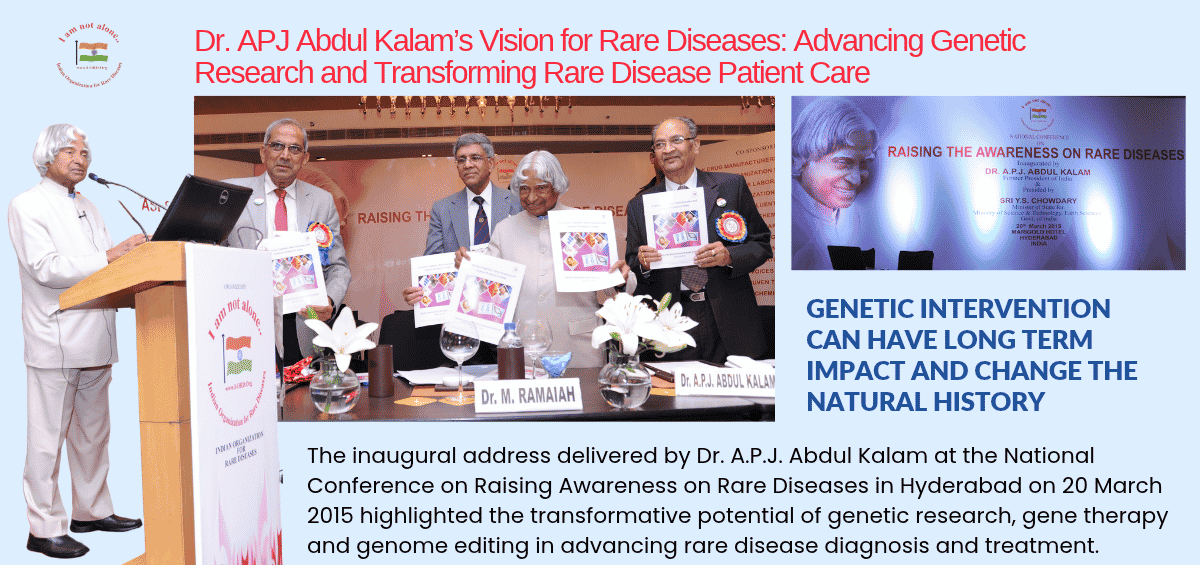
Dr. APJ Abdul Kalam’s Vision for Rare Diseases: Advancing Genetic Research and Transforming Rare Disease Patient Care
This is a transcription of the inaugural address delivered by Dr. A.P.J. Abdul Kalam at the National Conference on Raising Awareness on Rare Diseases, held in Hyderabad on 20 March 2015. Titled “Alone We Are Rare; Together, We Can Make a Difference!”, the address explores the importance of early diagnosis, genetic research, genome editing, rare disease registries and collaborative scientific efforts in addressing the challenges faced by people living with rare diseases.
Friends, I am happy to participate at the inauguration of the National Conference on Raising the Awareness on Rare Diseases. My greetings to all of you. When I am with you friends, I would like to share a few thoughts on “Alone we are rare; together, we can make a difference!”.
Friends, I feel even when there is no effective treatment, screening for early diagnosis, followed by suitable care, can improve quality of life and life expectancy.
The common denominator of rare diseases is the infrequency of their occurrence in the human population. The World Health Organization (WHO) defines often debilitating lifelong disease or disorder condition with a prevalence of 1 or less, per 1000 population as a rare disease. Of the several thousand, currently pegged around 7000 reported rare diseases or disorders, except for a handful, most do not have epidemiological data available. For the 7,000 known rare diseases, less than 400 have standard treatments.
Many rare diseases appear early in life, and about 30 percent of children with rare diseases will do not see their sixth birthday.
Many rare diseases are present throughout the person’s entire life, even if symptoms do not immediately appear. Rare diseases are also little known, little studied and they often lack of an adequate therapy. This is the reason that rare diseases are also called “orphan diseases” as they suffer low “desirability” for clinical and not many experimental researches take them up for their studies.
“Screening for early diagnosis, followed by suitable care, can improve quality of life and life expectancy.”— Dr. APJ Abdul Kalam
The low prevalence rate of these diseases causes a lower knowledge progress than theoretically possible and it leads to a non-application of what it is already known in current practice. Therefore, patients could suffer a double harm: being affected by a severe pathology, and being insufficiently recognized, diagnosed and cured.
So, when Dr Ramaiah Muthyala approached me on behalf of the Indian Organization for Rare Diseases, I accepted to participate to understand the magnitude of rare diseases in India and the experiences gained so far and above all to find solutions for certain rare diseases prevalent in the certain region in the country.
I have a long friendship with Prof Kakarla Subbarao. He is now 90 and has seen the medical science growing from simple clinical examination of vital signs to highly technology intensive genetic diagnostics.
I learnt from him that most rare diseases are genetic diseases, others are rare cancers, autoimmune diseases, congenital malformations, toxic and infectious diseases. While signs may be detected at birth or in childhood, over 50% of rare diseases appear during adulthood and are often life-threatening or chronically debilitating. Usually there is no effective treatment, but screening for early diagnosis, followed by suitable care, can improve quality of life and life expectancy.
Prof Subbarao told me that we can segregate rare diseases in to three groups for organizing our efforts to tackle them.
The first group is characterized by genetic disorders or by diseases supposed on genetic basis that are very rare, with a birth prevalence rate lower than 1 in 10,000, for example congenital heart diseases. The second group is about diseases that are quite frequent, like leukaemia, several shapes of tumours of the child and the adult, and infectious diseases like HIV, syphilis acquired, etc. The third groups includes typical pathologies of ageing characterized by a wide spread, like Alzheimer disorder, Parkinson, etc.
Typically, rare diseases have attracted little attention from the pharmaceutical industry due to their limited potential market. It is important that biotechnology and several pharmaceutical companies invest their efforts increasingly into developing therapeutic solutions to treat and manage rare diseases. I will share with you my three experiences that show that it can be done.
Mr friend Dr William Dar informed me that researchers are now able to alter the genes in plants to produce different types of plants with special characteristics, such as an increased resistance to diseases and pests or the ability to grow in difficult environments.
When I visited International Crop Research Institute of Semi Arid Tropics (ICRISAT) in Hyderabad last year, Dr Dar has shown me a number of Genetically Modified Plants tolerant to not only pests and insects but also to draught. I inaugurated their newly constructed greenhouse containment facility of the Platform for Translational Research on Transgenic Crops (PTTC). Similarly, the technique has to be perfected for gene re-engineering should be evolved on animal models, paving the way for treatment of human diseases.
Prof Jayesh Sheth and his wife Dr. Frenny Sheth are doing exemplary research work at Foundation for Research in Genetics and Endocrinology (FRIGE), Ahmedabad. I visited the last year and learned that gene therapy is a promising new field of medical research. Researchers try to supply copies of healthy genes to cells with variant or missing genes so that the “good” genes will take over the physiological function.
Viruses are often used to carry the healthy genes into the targeted cells because many viruses can insert their own DNA into targeted cells.
But there are problems with gene therapy. Unlike in plants, scientists still do not quite know what every gene in the human body does. Huge scientific efforts like The Human Genome Project and related projects have completed mapping of the entire human genome. But it will take many more years to find out what each gene does and how they interact with one another. Probably scientists have to accelerate the pace of the work.
For most diseases, scientists do not know whether and how genes play a role. Also, there are major difficulties in inserting the normal genes into the proper cells without causing problems for the rest of the body. The concept of gene therapy has been around for 25 years but we are not advancing beyond adding copies of genes that are defective. We must insert a corrected copy of the gene exactly where it should be. That means it is properly controlled and switched on and off as it should be.
During my visit at LV Prasad Eye Institute, Hyderabad, my friend Professor D Balasubramanian explained to me the new technique, called genome editing. In this new type of genetic engineering, DNA is inserted, replaced or removed from a genome using artificially engineered nucleases, or “molecular scissors.” It holds promise against a group of illnesses that run in families and are caused by faults in genes that underpin the healthy working of the immune system, bone marrow and liver.
The power to edit genes is as revolutionary, immediately useful and unlimited in its potential as was Johannes Gutenberg’s printing press. And like Gutenberg’s invention, most DNA editing tools are slow, expensive, hard to use and a brilliant technology in its infancy.
I propose the Indian Organisation for Rare Diseases to form a national consortium in this Conference to develop genome-scale editing tools as fast and easy as word processing, to rewrite the genome of living cells. Probably, this effort may find the solutions for certain rare diseases.
Photo gallery
Friends, I will now share with you some of my personal experiences on why some people give away all comforts and pleasures of their lives and pursue hard and difficult scientific pursuits. I have worked under the guidance of some truly great scientists and institution builders, namely Prof Vikram Sarabhai, Prof Satish Dhawan and Dr Brahm Prakash. I worked with hundreds and hundreds of brilliant scientists and engineers who gave shape to Satellite Launch Vehicles, Guided Missiles, and weaponised systems. In spite of technology denial, our scientists were all very passionate and led the team for self-reliance as a focus.
When I am in the midst of all of you, particularly researchers in rare diseases, I thought of articulating on what motivates a scientist.
Typically, research teams comprise post docs, graduate students and research assistants, individuals who have different career goals and are highly intelligent and want autonomy. Managing such teams can be very difficult at times. It is very important that primacy of scientists’ self-motivation must be supported with a broader mix of motives to include the social and affective aspects of intrinsic motivation. I suggest Indian corporate sector to encourage commercial engagement of scientists and support their reputational and intrinsic motivation with financial security.
Now I come to the most difficult problem that the scientific community is facing in today’s globalized world. Multinational pharmaceutical companies are one of the most profitable industries in the world and finance most clinical research in medicine. In contrast to governmental funding, the industry’s share in clinical research has been growing. While drug companies are responsible for much of the innovation in medicine, their role and influence in running clinical trials need to be carefully examined. And this responsibility rests with the Pharma scientific community.
Rare disease registries have now been recognized as a global priority for progress both in monitoring and documenting the natural course, and preventing and treating rare diseases. However, a disease registry is only one element of rare disease translational research. Let me outline what I believe are the ten key components in comprehensive rare disease translational research and describe critical relationships between them.
These components are: (i) doctor-patient partnerships; (ii) disease registries; (iii) bio-banks; (iv) genomics and other proteomics platforms; (v) community-based and population-wide studies; (vi) bioinformatics and high performance computing; (vii) interactions with pharmaceutical industry to facilitate drug discovery; (viii) personalized treatments based on genotype-phenotype correlations; (ix) e-Health and a whole of life record; and (x) regulatory frameworks, particularly with regard to specimen and data sharing, and the return of results.
Each component has its own inherent complexity, but if effectively integrated they will provide a comprehensive approach to the future management of rare diseases, and aid health care providers in delivering services to individuals affected with rare diseases.
We demonstrate that navigation through the roadmap can provide relevant health stakeholders with a blueprint to understand the challenges and barriers, which need to be overcome within and across the constituent components. The rare disease roadmap will assist decision-making at all health stakeholder levels and enable the seamless integration of new knowledge, standard operating procedures and the implementation of best practice.
It will take certain time to really identify whether the use of cutting edge genetic technology can lead to an increase in the rates of genetic diagnosis and simultaneously help doctors understand why certain patients are susceptible to developmental disorders. Issues like how genomic findings should be shared with individual research participants will arise due to the underlying ethical implications.
Large resources would be needed to collect high-resolution genomic and phenotypic data for children with severe undiagnosed developmental disorders and their parents and awareness of the long-term benefit of this data would be necessitated to raise these funds. This is only possible when we create a global initiative and this forum can play an important role in this mission.
The most challenging problem of human civilization right now is that science is gathering knowledge faster than society is gathering the wisdom.
Since the time of Hippocrates, the history of medicine has been one of ever more sophisticated phenotyping: these are the signs of diabetes; those, the symptoms of Alzheimer disease. Medicine’s ability to understand and treat disease has hinged on this careful phenotyping of patients.
Modern genetics now has historic opportunity to complete the symmetry of this equation by bringing genotyping to the traditionally phenotypic endeavor of clinical medicine. And while the complexity of this information is a barrier to its implementation, medical geneticists and genetic counselors are well positioned to deal with this emerging volume of information, ensuring our relevance to medical practice.
The Pharma researchers also bear the additional burden of safeguarding ethics and moral values surrounding the work done outside our country. From sequence analysis to microarrays, unprecedented amounts of medical information are being generated which will soon directly pertain to patient care. It is high time that Indian medical geneticists demonstrate to clinicians and policy makers that their activities are necessary to patient care and genetics must emerge as part of medicine’s mainstream.
The specificities of rare diseases – limited number of patients and scarcity of expertise – single them out as a distinctive domain where international collaboration has high added value. Knowledge must be shared and resources combined as efficiently as possible to tackle rare diseases effectively as a whole.
Historically, health authorities have not systematically considered rare diseases to be a public health issue and rare diseases have not been the focus of research programs due to a lack of data. Today, however, most developed nations have launched national plans on rare disease research and management and India is not far behind.
With these words, I inaugurate National Conference on Raising the Awareness on Rare Diseases and wish all its members a fulfilling scientific career in tackling rare diseases and mitigating the human suffering.
May God Bless.
“Alone we are rare; together, we can make a difference!”— Dr. APJ Abdul Kalam