New Delhi: The Indian Organisation for Rare Diseases (IORD) has submitted a set of Supplementary Quality Indicators for the Safety of People Living with Rare Diseases to NITI Aayog, following its participation in the stakeholder consultation on developing a National Quality Indicator Framework for Hospitals.
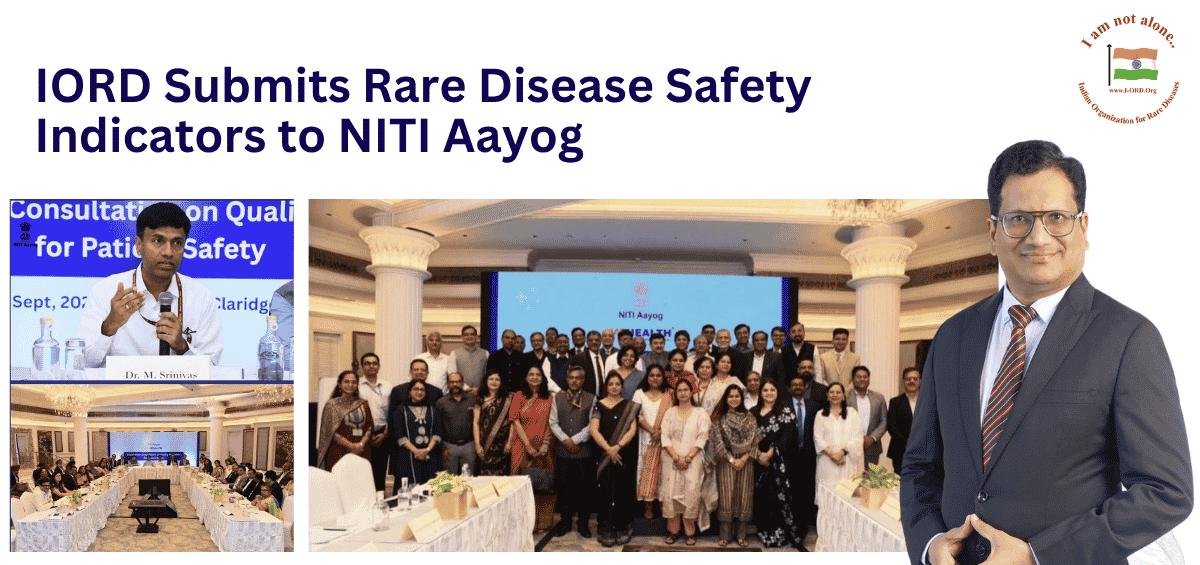
The indicators were submitted to Dr. M. Srinivas, Chair and Member, NITI Aayog, Government of India by IORD following its participation in the Stakeholders Consultation on Quality Indicators for Patient Safety, held on September 22, 2026, at The Claridges, New Delhi.
The consultation, organised by NITI Aayog in partnership with NATHEALTH, brought together regulators, policymakers, academicians, clinicians, multilateral organisations and patient-safety groups to discuss strengthening patient-safety measurement and outcomes.
“For a person living with a rare disease, patient safety begins well before hospital admission. A missed diagnosis, delayed referral, unavailable medical history, inappropriate medication, interruption of essential treatment or failure of follow-up can each become a patient-safety event,” said Krishnaji Rao Mutyala, Secretary, Indian Organisation for Rare Diseases.
During the stakeholder consultation, IORD highlighted patient-safety risks that can arise at different stages of rare disease care, including diagnostic delays, inappropriate or delayed referrals, fragmented care, loss of clinical information during transitions, medication-related risks, treatment interruptions and inadequate continuity of follow-up.
Unlike conventional hospital quality measures, the proposed supplementary indicators are designed to capture patient-safety dimensions that are particularly relevant to rare diseases. IORD has stressed that these indicators are complementary to—not duplicative of—the core national hospital quality indicators.
The proposed framework therefore looks beyond individual hospital encounters and considers whether a patient is safely navigated through the wider continuum of care—from early recognition and diagnosis to referral, treatment, monitoring, transition and lifelong follow-up.
Using existing hospital data
IORD has also proposed a practical approach to implementation that would avoid creating a separate reporting burden for hospitals and healthcare professionals.
Wherever feasible, the supplementary indicators could be integrated into systems already used in routine healthcare, including hospital information systems, electronic medical records, laboratory systems, pharmacy records, referral systems, discharge summaries and existing quality and patient-safety reporting mechanisms.
The proposed model is: Existing clinical data → rare-disease identification/tagging → automated indicator generation → quality review → benchmarking → corrective action
Under this approach, hospitals would primarily use information already generated during routine clinical care, with appropriate identification or classification of rare disease cases. As digital health and interoperable health-information systems develop, the indicators could progressively become part of automated quality monitoring.
IORD has also proposed a phased implementation, beginning with a limited number of high-priority indicators, followed by validation and refinement before eventual integration into national quality benchmarking systems.
From policy recognition to measurable action
India has taken significant steps towards addressing rare diseases through the National Policy for Rare Diseases (NPRD), 2021, and subsequent initiatives. The NITI Aayog consultation provides an opportunity to extend that policy framework into measurable patient-safety practices at the point of care.
The proposed indicators are intended to help identify whether people living with rare diseases are receiving safe and continuous care, particularly in situations where fragmented healthcare pathways can increase risk.
IORD has shared the supplementary indicators with stakeholders participating in the consultation in both hard-copy and soft-copy formats for consideration. The organisation has also expressed its readiness to support NITI Aayog and other relevant stakeholders in further refining, validating and operationalising the indicators and providing technical inputs during subsequent stages.
The submission marks another step towards translating India’s rare disease policy commitments into measurable standards for safer, more coordinated and patient-centred care.
For a person living with a rare disease, patient safety begins well before hospital admission. A missed diagnosis, delayed referral, unavailable medical history, inappropriate medication, interruption of essential treatment or failure of follow-up can each become a patient-safety event — Krishnaji Rao Mutyala, Secretary, Indian Organisation for Rare Diseases.