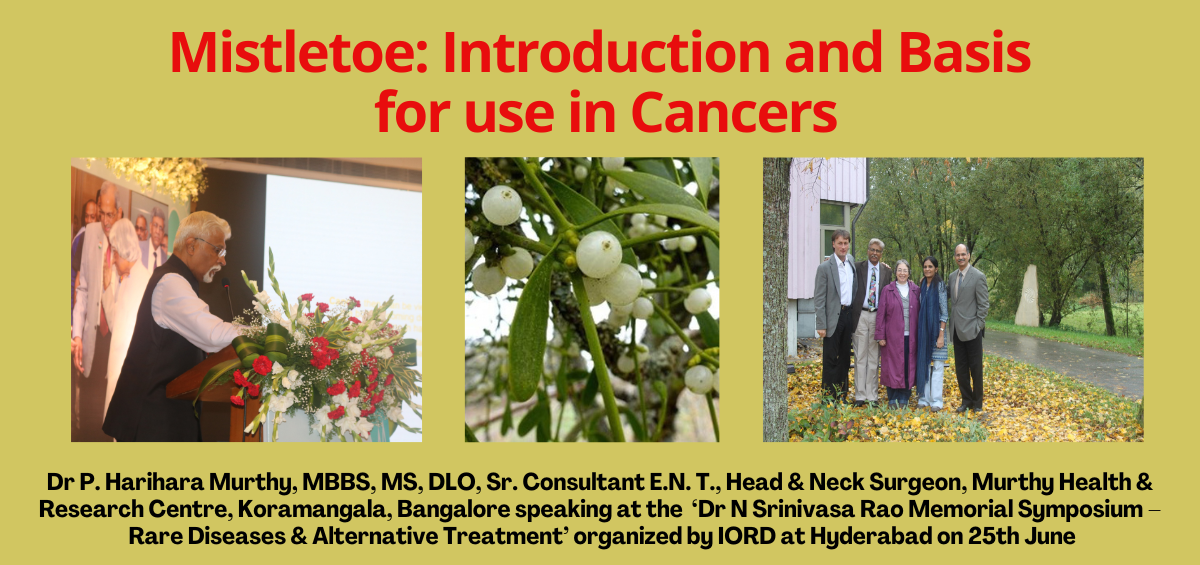
(This is an abridged version of the presentation delivered by Dr P. Harihara Murthy, MBBS, MS, DLO, Sr. Consultant E.N. T., Head & Neck Surgeon & Anthroposophic Physician, Swasthya Niketan, Koramangala Bangalore, Murthy Health & Research Centre, Koramangala, Bangalore & Apollo Spectra Hospital, Koramangala, Bangalore at the ‘Dr N Srinivasa Rao Memorial Symposium – Rare Diseases & Alternative Treatment’ organized by IORD at Hyderabad on 25th June.)
Introduction:
Arbudha Roga – illustrated by the ancient Indian Surgeon in great detail in the Sushrutha Samhitha predating the Christian era, where it has been described as a disease which has no definitive cure. To date, we have had in modern medicine many modalities of treatment and many medicines that have been used with very variable results and side effects. We are in the ongoing study of an ill-understood disease and the difficult treatment for it.
Properties of the Mistletoe Plant:
Mistletoe (Viscum album L) is an unusual plant with many unusual properties. First, it does not grow on the ground, it grows in the bark of various types of trees high up in the air amongst the branches of the host tree. Second, instead of going dormant or dying during the winter-time, it bears its fruit, a small white berry, in the snow and ice of winter. Third, it stores chlorophyll down into its roots and is green all year long and is indifferent to light. Thus, it is neither geotropic nor phototropic.
Rationale for Remedy:
The extracts are unique in that the juices of the summer and winter plants must be combined, as the summer plant is at the height of its vegetative growth, and the winter plant has in some ways concluded its life rhythm by combining these two extracts and thus these two different components of life, an anti-cancer treatment is created.
Cancer, then, can be viewed as the cold, sclerotic forces of the body becoming dominant to the other two aspects, instead of being in harmony with them. The absence of the balancing of the hardening sclerotic forces and the warming inflammatory processed
The Four-Fold Approach:
Humans are viewed as having four different levels of being, or existence. First is the physical body. The physical realm is the most basic; it is what we share with all plants, animals, rocks and minerals (it represents the physical world; the element earth).
Second is the life-forces body, or, etheric body; it is what we share with plants and animals (it takes hold of the physical world through the element water).
The third is the astral body, or soul (it takes hold of the physical world through the element air). Man, and animals are bestowed with consciousness; they are not fixed in one place and they are all capable of feelings, we all share this body.
The last is that which humans have alone. Through the effects of the Ego, man becomes his typical human shape, and becomes an erect being. Human beings have an ego (spirit) and are therefore self-conscious. The ego takes hold of the physical through the element of fire or warmth.
Pathogenesis:
When a person develops cancer, it is thought this is because their Ego has left the cells of their body to a certain extent, and have lost their ability for differentiation, thus a type of downward regression occurs (normal cells regress into a more embryonic state) the more they regress in this way, the more undifferentiated they become, expressing their more aggressive growth pattern, and tendency to metastasize.
Interestingly, the ego- and astral forces bringing consciousness and self-consciousness and which work through the nerve-sense system downwards, may become too destructive and, by flowing from the head down into the metabolic limb system, induce inhuman growths.
There, Steiner declared, these forces tend to form swellings, and malformations, thus leading to carcinomatous growths
Finally, anthroposophy seeks to explain cancer as an effect of spiritual disharmony as well. The rise of cancer today is likely a direct consequence of the current development of mankind as a whole.
Our current movement towards the separation of the spirit from the body and intellectualization has extended consciousness into realms of bodily activities that were formerly unconscious or were controlled in rhythmic subconsciousness.
Increase in the carcinomatous diseases in our day is paralleled by the widespread development of the forces of the intellect. Similar to the cold, sclerotic body moving downward, the movement of the intellect into other parts of the human being has led to the distortion of balance in the physical organism.
The intellect has grown out of balance in the human soul and spirit.
The powers of Thinking (Ego), having lost the sense of their true relation to the spirit, have associated themselves in purely Intellectual Thinking (Ego-Astral) with the instincts of Life and growth (the Etheric) in the lower bodily nature of man – as centred on and satisfied by the material work – and the feeling-life arising out of that lower nature. Thus, the origin of the physical imbalance called disease would be related to the human spiritual imbalance – scientific materialism.
MISTLETOE: HOST TREES
Apple: Viscum Mali
Elm: Viscum Ulmi
Fir: Viscum Abietus
Pine: Viscum Pini
Oak: Viscum Quercus
Cytotoxic Properties:
Lectins: ML-1, ML-2, ML-3, and Viscum album chitin-binding agglutinin have been identified in mistletoe extracts. ML-1 (or viscumin) may be responsible for many of mistletoe’s biological effects. The molecular structure of ML-1 consists of an alpha chain and a beta chain, which can be separated from one another.
Each chain type appears to mediate a subset of the activities described for the intact lectin. Cytotoxicity is associated mainly with the alpha chain. In laboratory studies, the ML-1 alpha chain has been coupled to monoclonal antibodies to produce immuno-toxins that target and kill specific cell types.
The beta chain of ML-1 is responsible for binding to the surface of a target cell. Studies of mistletoe lectin binding to cancer cells have examined whether the extent of cell binding can predict disease outcome or survival. Laboratory studies have shown that mistletoe extracts can stimulate the activity of white blood cells in vitro and cause them to release molecules thought to be important for anticancer immune responses. Mistletoe extracts have demonstrated cytotoxic activity against a variety of mouse, rat and human cancer cells in vitro.
When a laboratory method was used to selectively deplete ML-1 from Viscum album extracts, their cytotoxic and immune-system-stimulating properties were markedly reduced.
Cancer Fighting Properties: Mistletoe is a biological response modifier. It
a) Stimulates the thymus, the chief regulator of cellular immune reactions.
b) Increases the number of granulocytes, which are the scavenger white blood cells that consume invading antigens, Protects the D N A in WBCs including those exposed to radiation and Chemo-therapeutic drugs
c) Immune-system-enhancing cytokines, such as interleukin-1, interleukin-6 & TNF-α (tumour necrosis Factor-alpha)
d) Mistletoe elevates the number of immuno-competent white cells and activates natural killer cells capable of spontaneously destroying tumour cells.)
e) Mistletoe extract also contains biologically active proteins (lectins) and other substances that have exhibited powerful anti-tumour action in animal and cell-culture experiments
f) Enhances phagocytosis, the white blood cells’ ability to ingest and destroy other cells or foreign material.
Apoptosis of cancer cells is a very well-established result of mistletoe. It also prevents neo-vascularization that is required for the proliferation of solid tumours.
Results:
Mistletoe has been used mainly as:
- Adjunct to surgery
- Radiation
- Chemotherapy
Mistletoe therapy improves the survival rates for cancers of the following:
- Cervix
- Ovaries
- Brain
- Vagina
- Breast
- Prostate
- Stomach
- Colon
- Lung
- Slowing of tumour growth
- Occasional regression of tumours
- Remission
The best results have been obtained in the treatment of solid tumours both before and after surgery and radiotherapy.
Survival Rates & Pre-Op:
Mistletoe therapy improves the survival rates for cancers of the cervix, ovaries, vagina, breast, stomach, colon, bone and lung as well as other locations.
Preoperative mistletoe therapy is given for ten to fourteen days before surgery. It aims to help prevent the metastatic spread of cancer due to surgical intervention.
Post-Op Treatment:
Post-operative treatment is ideally begun immediately after surgery or radiotherapy. This follow-up treatment reportedly reduces the risk of recurrence after surgery or radiation.
Mistletoe is usually administered by subcutaneous injection at or near the tumour site. A typical course of treatment consists of fourteen injections given in increasing concentrations.
Administration:
Injections –
- Sub cutaneous
- Intravenous
- Intra Pleural
- Intra tumoral
- Intra peritoneal
- Oral Medication
Brands of Mistletoe:
- Abnoba VISCUM
- Eurixor
- Helixor
- Iscador
- Isorel (Vysorel)
- Iscucin
- Lektinol (Plenosol)
SIDE EFFECTS:
- Inflammation
- Local rashes
- Lymphadenopathy
- Headache
- Fever
- Chills
- Reversible hepatotoxicity
- Raised intracranial tension
- Anaphylactic shock
Hospitals Using Mistletoe:
Clinic in LIFE Gartenweg 5-6 07973 Greiz
Naturopathy Königstr. 63 14109 Berlin-Wannsee
Sonnenberg Klinik Hardtstr. 13 37242 Bad Sooden-Allendorf
Vita Natura clinic Altschloßstr. 1 66957 Eppenbrunn
BioMed Klinik Bad Bergzabern table Str 5-8. 76887 Bad Bergzabern
Hospital for Natural Healing Sanatorium Platz 2 81545 München
Waldhausklinik Deuringen GmbH Sandbergstr. 47-49 86391 Stadtbergen
Hufeland Clinic Löffelstelzer Str 1-3. 97980 Bad Mergentheim
Medical Center Kalden Mommsenstr. 57 10629 Berlin
Anthroposophic hospitals
Havelhöhe hospital clinic for anthroposophic medicine advanced Kladower Damm 21 14089 Berlin
Asklepios Hospital Hamburg West Station for Integrative Medicine Suurheid 20 22559 Hamburg
Herdecke Community Hospital Gerhard-Kienle-Weg 4 58313 Herdecke / Ruhr
Filderklinik In Haberschlai 7 70794 Filderstadt (Bonlanden) Stuttgart
Paracelsus Hospital Burghaldenweg 60 75378 Bad Liebenzell-inferiority Hardt
Clinic Lahnhöhe
Regional Center for Psychosomatic Medicine and holistic medicine (only for patients who require additional psychotherapy) Am Kurpark 1 56112 Lahnstein
Klinik Arleshiem, Arleshiem, Switzerland
Paracelcus Spital, Zurich, Switzerland
Haus Am Stalten, Germany
Anthroposophic sanitarium or rehabilitation hospitals
Rehabilitation Clinic, Schloss Hamborn, Schloss Hamborn 85
Clinics Sonneneck Kanderner Straße 18 79410 Badenweiler Sanatorium house Stalten Staltenweg 25 79585 Steinen
Naturopaths Archaeus – Institute of Naturopathy Werner Schmötzer Klingenhaldenweg 2372175 Dornhan