+91-9666438880
indiaord@gmail.com
IORD – Indian Organization for Rare DiseasesIORD – Indian Organization for Rare DiseasesIORD – Indian Organization for Rare DiseasesIORD – Indian Organization for Rare Diseases
  • Home
  • About Us
    • Management Committee
    • Advisory Board
    • Newsletters
    • Newsletter Subscription
  • Rare Diseases
  • Research
  • Services
  • Donate
  • Gallery
    • Photo Gallery
      • World Rare Disease Day – 2023
      • World Rare Disease Day 2020
    • Video Gallery
      • World Rare Disease Day – 2020
      • World Rare Disease Day – 2019
      • World Rare Disease Day – 2018
  • Blog
  • Contact Us

A Heartbreaking Battle Against ALD: A Family’s Fight for Their Son’s Life

    Home Rare Disease News A Heartbreaking Battle Against ALD: A Family’s Fight for Their Son’s Life
    NextPrevious
    • Amol Maurya, a 7-year-old boy from Pratapgarh, Uttar Pradesh, is undergoing high-risk treatment for Cerebral Adrenoleukodystrophy (CALD).

    A Heartbreaking Battle Against ALD: A Family’s Fight for Their Son’s Life

    By IORD | Rare Disease News, Rare Disease Survivor | 0 comment | 19 June, 2025 | 3

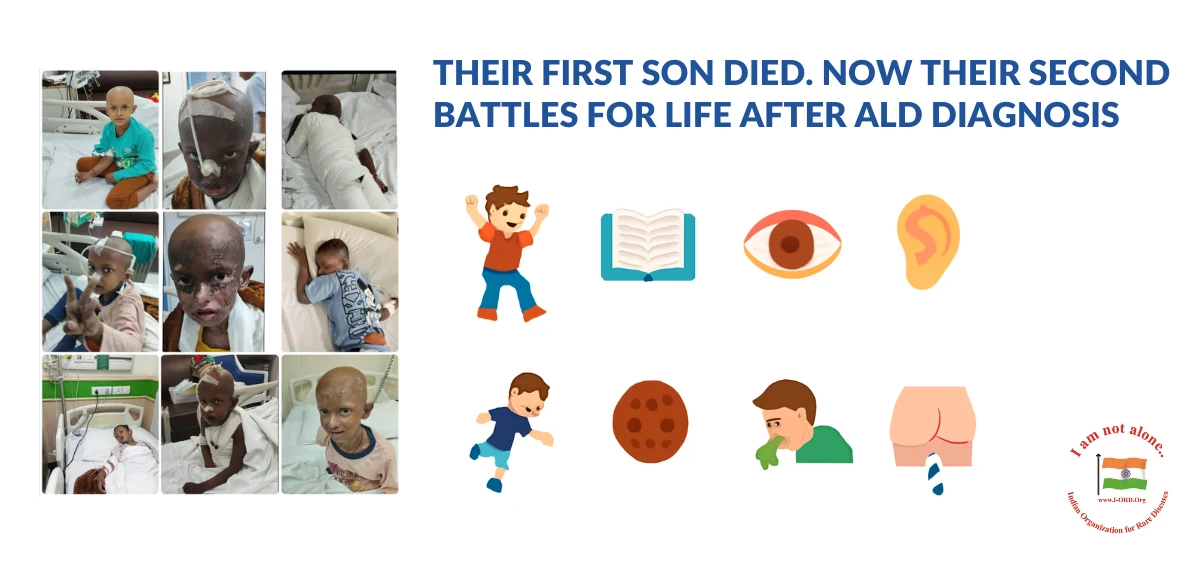
    Back in 2020, three-year-old Amol was diagnosed with Adrenoleukodystrophy (ALD), a  genetic disorder linked to the X chromosome. That marked the beginning of a long and exhausting journey for his family—not just against the disease, but against every passing day that seemed to steal a little more of his childhood.


    “We started regular MRIs, trying to stay ahead of whatever came next. Treatment for Addison’s disease was ongoing. Doctors told us he had slow growth since birth, was hyperactive, but nothing seemed immediately alarming. Still, something didn’t sit right,” said his father, Vijay Maurya.


    Amol laughed, played, stumbled—at first, we thought it was normal. But then the falling became frequent. He started struggling to walk. Balance issues crept in. His legs trembled; bruises became routine. Walking, something so natural, became a daily battle.


    “In September 2024. The MRI report arrived—and our hearts refused to believe it. He was diagnosed with Cerebral ALD, most severe and progressive form of ALD. Those weren’t just medical terms for us—they spelled out our child’s future. His memory, his speech, his innocent laughter—everything was now at risk,” recalled Mr Maurya.


    The moment Amol’s family heard the diagnosis, they didn’t waste a second. A Bone Marrow Transplant (BMT) was the only known hope. That desperate hope pulled them all the way to Delhi—clinging to a thread that was fragile, but still holding.


    Seeking Help

    After Human Leukocyte Antigen (HLA) test, the family found a 100% match donor but unfortunately, he refused, as a result bone marrow was taken from father (half match), which increases complications during BMT. His father, Vijay Maurya, now pleads with the public for financial support, as the cost of life-saving care has already exceeded ₹50 lakhs. Initially, the doctor estimated the cost of treatment to be about 20-25 lakhs.


    Types of adrenoleukodystrophy (ALD)

    There are four types of ALD:

    1. Childhood cerebral adrenoleukodystrophy (also known as cerebral ALD, CALD, or CCALD)
    2. Adrenal insufficiency, also called Addison’s disease
    3. Adrenomyeloneuropathy, a form of ALD that affects the spinal cord and nerves, typically in adult men
    4. Asymptomatic ALD, which occurs in people who have a mutation in the ABCD1 gene but no symptoms.

    Symptoms:

    • Hyperactivity: Quick temper, throwing things when upset. Self-harming behavior, such as pressing or choking the neck.
    • Learning Disablities: Progressive learning difficulties, poor academic performance, and inability to write down what has been studied during exams.
    • Visual Impairment: Seeing double (for example, the child often said, “Mom, you look like two people”). Difficulty focusing, with the vision appearing skewed or tilted.
    • Hearing Loss: Difficulty hearing from both ears.
    • Poor Coordination: Difficulty with coordination, leading to frequent falls while playing or walking home from school.
    • Increased Skin Pigmentation: Darkening of the skin (due to Addison’s disease).
    • Intermittent Vomiting: Occasional vomiting, particularly during travel.
    • No Motion Control: Inability to control bowel movements, sometimes leading to accidents (especially at school). Urgent need to go to the bathroom when the urge strikes at home.


    Incidence:

    Cerebral adrenoleukodystrophy, also known as cerebral ALD or CALD, affects the brain, occurs in about 1 in 21,000 boys between ages 4 and 10, affecting about 35 to 40 percent of boys with the ABCD1 mutation. Females with the ABCD1 mutation are highly unlikely to develop CALD.

    Family Shattered by Multi-Generational Genetic Illness

    The Maurya family has suffered greatly from Adrenoleukodystrophy (ALD). In 2019, Amol’s elder brother was diagnosed at age 9. Despite consultations at AIIMS, New Delhi, his advanced disease left no treatment options. He died in July 2021, after two years in a coma.

    A year later, both Amol and his maternal uncle were diagnosed with the condition. The uncle has since developed severe bladder dysfunction and vision loss. Genetic screening revealed that Amol’s mother and grandmother are carriers, indicating a high-risk profile across the family.

    Rapid Disease Progression Sparks Urgent BMT

    Amol’s initial MRI in September 2024 showed a Loes score of 1 (Loes Score is a radiological scoring system used to assess the severity and progression of Cerebral Adrenoleukodystrophy), suggesting early-stage CALD. But within just one month, the score surged to 6 — a warning of fast-advancing neurological damage.

    Doctors at Sir Ganga Ram Hospital, New Delhi, advised an urgent bone marrow transplant. Although a full-match donor was initially identified, they withdrew. With no time to spare, Vijay Maurya donated his own bone marrow despite being a half-match — a decision that increased the risk of post-transplant complications.

    Painful Complications After Transplant

    The BMT was performed on December 19, 2024, following rounds of chemotherapy. In the weeks that followed, Amol faced severe complications:

    • CMV virus activation, causing painful mouth ulcers and skin burns
    • Liver and kidney infections
    • Subsequent Adenovirus infection, causing recurring fever and hospitalizations
    • Discovery of congenital duplex kidneys and a smaller right kidney, adding to the complexity of treatment

    A recent Chimerism report confirmed 100% DNA match from his father, indicating transplant success — but doctors say ongoing care is essential for at least one year.


    Treatment Cost Spirals Beyond Reach

    So far, Amol’s treatment has cost the family over ₹50 lakhs. With weekly tests, blood transfusions, medications, and hospital stays, the financial burden is growing unsustainably.

    “I’ve already lost one son to this disease,” said Vijay Maurya. “I’ve given my bone marrow to save Amol. But we cannot afford to continue without help.”


    What Is CALD and Why Early Detection Matters

    CALD is a severe form of Adrenoleukodystrophy, a genetic condition caused by mutations in the ABCD1 gene. It leads to the accumulation of very-long-chain fatty acids (VLCFAs) in the brain and adrenal glands. CALD mostly affects boys between ages 4 and 10 and is fatal within 2–3 years if not treated early.

    Early detection through genetic testing and regular MRI scans is critical. Once neurological damage sets in, it becomes irreversible.


    Emerging Treatment Options and Trials in India

    Treatment options for CALD include:

    1. Gene therapy (SKYSONA) – Available in India but unaffordable for most families
    2. Stem cell transplant – A lifesaving method using a genetically matched donor’s healthy cells

    A new investigational drug, Leriglitazone, is now on trial in AIIMS and Sir Ganga Ram Hospital. While early data is promising for AMN, its effect on CALD is yet to be confirmed.

    A Father’s Plea: “One More Effort Could Save Him”

    The Maurya family has created a Facebook page to raise awareness about ALD.

    “We have been through unimaginable pain,” says Vijay Maurya. “If we lose Amol, it won’t be because the treatment failed — it will be because we couldn’t afford to finish it.”

    The family has also started a crowdfunding page to support Amol’s treatment, holding onto hope and asking for help in the toughest fight of his life.

    • Amol Maurya, a 7-year-old boy from Pratapgarh, Uttar Pradesh, is undergoing high-risk treatment for Cerebral Adrenoleukodystrophy (CALD).
    • His elder brother died from the same condition, while several other family members are affected or carry the gene.
    • With treatment costs exceeding ₹50 lakhs, Amol’s father, Vijay Maurya, has issued a public appeal for help.
    Amol Maurya CALD, Bone Marrow Transplant cost India, Cerebral ALD treatment India, Genetic disorder in children, Pratapgarh rare disease, Sir Ganga Ram ALD case, Vijay Maurya ALD

    IORD

    More posts by IORD

    Related Post

    • Dr. Anil Kumar Mandal, Senior Consultant Ophthalmologist at Centre for Sight, Banjara Hills, delivered a powerful keynote address at IORD’s World Rare Disease Day 2026.

      Dr. Anil Kumar Mandal: 40-Year Journey Advancing Care in Congenital Glaucoma

      By IORD | 0 comment

      This is a transcribed keynote address by Dr. Anil Kumar Mandal, Senior Consultant Ophthalmologist at Centre for Sight, Banjara Hills, delivered at the Indian Organisation for Rare Diseases (IORD) World Rare Disease Day 2026 event in Hyderabad, focusing on rare ophthalmic disorders.

    • Indian Organisation for Rare Diseases (IORD) CEO and President Dr. Ramaiah addressing the audience on Rare Ophthalmic Disorders at World Rare Disease Day 2026 event organised at Hyderabad on 28 February in collaboration with L V Prasad Eye Institute (LVPEI) and Rainbow Children’s Hospital.

      World Rare Disease Day 2026: Dr. Ramaiah Muthyala Focuses on Rare Ophthalmic Disorders

      By IORD | 0 comment

      This is a transcribed speech of Indian Organisation for Rare Diseases (IORD) President and CEO, Prof. Ramaiah Muthyala, delivered at the World Rare Disease Day 2026 event in Hyderabad, focusing on rare ophthalmic disorders.

    • Inaugural session of World Rare Disease Day 2026 conference in Hyderabad, with experts from IORD, LVPEI, and Rainbow Children’s Hospital

      India: Rare Ophthalmic Disorders Take Centrestage at World Rare Disease Day-2026

      By IORD | 0 comment

      IORD marked World Rare Disease Day 2026 highlighting rare ophthalmic disorders, stressing early diagnosis, better referrals, and expanded genetic, multidisciplinary care with expert participation.

    • On World Rare Disease Day 2026, IORD, along with LV Prasad Eye Institute and Rainbow Children’s Hospital, is hosting a scientific conference in Hyderabad focused on Rare Ophthalmic Disorders

      IORD to Host World Rare Disease Day 2026 Conference Focused on Rare Ophthalmic Conditions

      By IORD | 0 comment

      IORD will host a World Rare Disease Day 2026 conference in Hyderabad on rare ophthalmic conditions, with LVPEI and Rainbow Children’s Hospital.

    • In this letter, IORD urges the Government of India to ensure affordable access to orphan drugs for rare disease patients through a public-interest, Section 8 non-profit pharmaceutical model supported by CSR funding.

      Bridging India’s Rare Disease Treatment Gap Through Public-Interest Pharmaceuticals

      By IORD | 0 comment

      IORD proposes a Section 8, CSR-supported public-interest pharmaceutical model to ensure affordable access to orphan drugs for millions of Indian patients.

    NextPrevious

    Categories

    • ABN Andhra Jyothi
    • ANI
    • Deccan Chronicle
    • Economic Times
    • Eenadu
    • Events
    • IORD in News
    • IORD Updates
    • News
    • Pharmabiz.com
    • Prime9 News
    • Rare Disease News
    • Rare Disease Survivor
    • Sakshi
    • Telangana Today
    • The Hans India
    • The Hindu
    • The Pioneer
    • Times Now
    • Times of India
    • Uncategorised
    • Vaartha
    • World Rare Disease Day 2026

    Recent Posts

    • Dr. Anil Kumar Mandal: 40-Year Journey Advancing Care in Congenital Glaucoma
    • World Rare Disease Day 2026: Dr. Ramaiah Muthyala Focuses on Rare Ophthalmic Disorders
    • India: Rare Ophthalmic Disorders Take Centrestage at World Rare Disease Day-2026
    • IORD to Host World Rare Disease Day 2026 Conference Focused on Rare Ophthalmic Conditions
    • Bridging India’s Rare Disease Treatment Gap Through Public-Interest Pharmaceuticals

    Archives

    • April 2026
    • March 2026
    • February 2026
    • January 2026
    • November 2025
    • October 2025
    • September 2025
    • August 2025
    • July 2025
    • June 2025
    • May 2025
    • April 2025
    • March 2025
    • February 2025
    • January 2025
    • December 2024
    • November 2024
    • September 2024
    • July 2024
    • June 2024
    • May 2024
    • March 2024
    • February 2024
    • December 2023
    • October 2023
    • July 2023
    • June 2023
    • May 2023
    • April 2023
    • March 2023
    • February 2023
    • January 2023
    • December 2022
    • November 2022
    • October 2022
    • September 2022
    • August 2022
    • June 2022
    • May 2022
    • April 2022
    • March 2022
    • February 2022
    • January 2022
    • December 2021
    • November 2021
    • October 2021
    • September 2021
    • August 2021
    • July 2021
    • May 2021
    • April 2021
    • November 2020
    • March 2020
    • February 2020
    • January 2020
    • February 2019
    • January 2018
    • September 2015

    IORD

    Indian Organization For Rare Diseases (IORD), a not-for-profit umbrella organization represents interests of all stakeholders of Rare Diseases in India including individual patients, patient support groups, health policy advocates and health care providers.

    RARE DISEASES

    • Rare Blood Diseases
    • Rare Heart Diseases
    • Rare Fungal Diseases
    • Rare Kidney Diseases
    • Rare Newborn Diseases
    • more...

    SERVICES

    • Research
    • Let's Come Together
    • Partner With Us
    • Volunteers
    • Privacy Policy
    • Sitemap

    CONTACT US

    Indian Organization For Rare Diseases
    Registered Office (India):
    Plot No. 397, Road No. 22B, Jubilee Hills, Hyderabad – 500033, Telangana, India.

    Phone: +91-9666438880

    Email: indiaord@gmail.com

    © 2020 Indian Organization For Rare Diseases | All Rights Reserved. Powered By Digital Dynamics
    • Home
    • About Us
      • Management Committee
      • Advisory Board
      • Newsletters
      • Newsletter Subscription
    • Rare Diseases
    • Research
    • Services
    • Donate
    • Gallery
      • Photo Gallery
        • World Rare Disease Day – 2023
        • World Rare Disease Day 2020
      • Video Gallery
        • World Rare Disease Day – 2020
        • World Rare Disease Day – 2019
        • World Rare Disease Day – 2018
    • Blog
    • Contact Us
    IORD – Indian Organization for Rare Diseases