+91-9666438880
indiaord@gmail.com
IORD – Indian Organization for Rare DiseasesIORD – Indian Organization for Rare DiseasesIORD – Indian Organization for Rare DiseasesIORD – Indian Organization for Rare Diseases
  • Home
  • About Us
    • Management Committee
    • Advisory Board
    • Newsletters
    • Newsletter Subscription
  • Rare Diseases
  • Research
  • Services
  • Donate
  • Gallery
    • Photo Gallery
      • World Rare Disease Day – 2023
      • World Rare Disease Day 2020
    • Video Gallery
      • World Rare Disease Day – 2020
      • World Rare Disease Day – 2019
      • World Rare Disease Day – 2018
  • Blog
  • Contact Us

Bridging India’s Rare Disease Treatment Gap Through Public-Interest Pharmaceuticals

    Home IORD Updates Bridging India’s Rare Disease Treatment Gap Through Public-Interest Pharmaceuticals
    NextPrevious
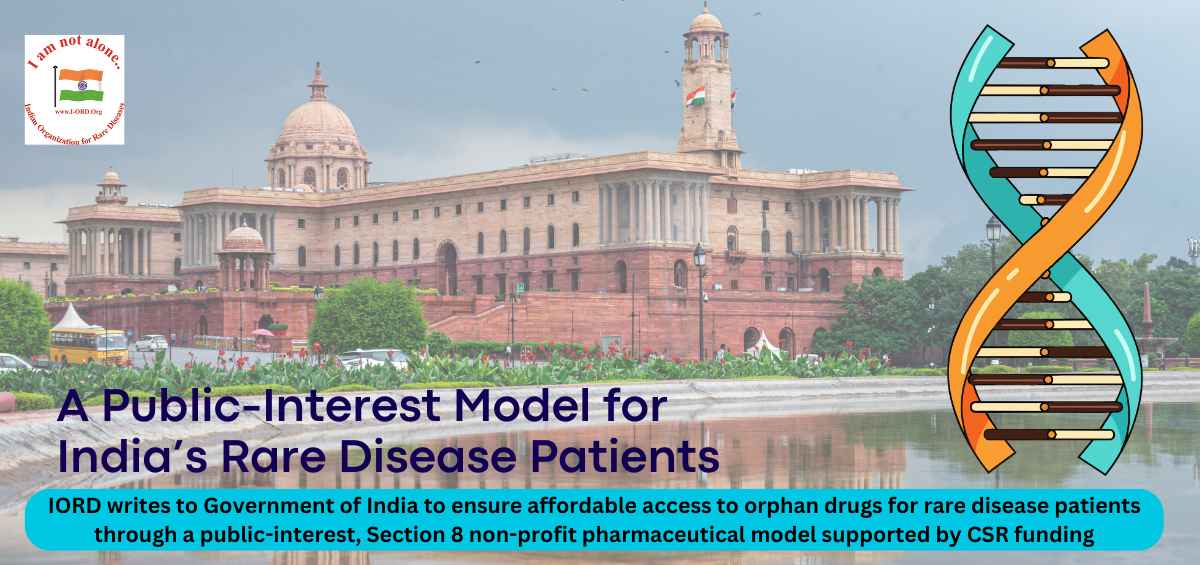
    In this letter, IORD urges the Government of India to ensure affordable access to orphan drugs for rare disease patients through a public-interest, Section 8 non-profit pharmaceutical model supported by CSR funding.

    Bridging India’s Rare Disease Treatment Gap Through Public-Interest Pharmaceuticals

    By IORD | IORD Updates, Rare Disease News | 0 comment | 10 January, 2026 | 0

    Reproduced below is the letter addressed by IORD President and CEO Prof. Ramaiah Muthyala to the Government of India, advocating affordable access to orphan drugs for rare disease patients through a public-interest, Section 8 non-profit pharmaceutical model supported by CSR funding.

    India is often described as the “pharmacy of the world,” yet patients living with rare diseases continue to face minimal access to treatment. More than 90 million Indians are affected by over 7,000 rare diseases, but only around 5 per cent have any approved therapy. Even when treatments are available, they are often prohibitively expensive, leaving families with few realistic options for long-term care.

    Policy measures have begun to emerge. Following a writ petition in the Delhi High Court, the government established the National Fund for Rare Diseases, allocating ₹974 crore for 2024–26. The National Policy for Rare Diseases (NPRD), introduced in 2021, categorises 63 rare diseases into three groups based on prevalence and treatment availability. Yet, despite these frameworks, patients continue to encounter limited availability in hospitals, long procurement delays, and sharply uneven access across states.

    A major constraint lies in the economics of orphan drugs. Most rare diseases affect tiny groups of patients—89 per cent occur at frequencies below one per 100,000 people—making drug development and manufacturing commercially unattractive. Meanwhile, India already manufactures and exports the active pharmaceutical ingredients (APIs) for many orphan drugs whose patents have expired. Nearly 600 U.S. FDA–approved orphan drugs are now eligible for generic production. Yet, Indian patients often cannot access these medicines because the finished formulations are not produced for the domestic market. The problem is not a lack of capacity; it is the absence of a viable business model.

    One solution is to create a public-interest pharmaceutical entity under Section 8 of the Companies Act, 2013, supported by Corporate Social Responsibility (CSR) funding under Section 135 of the Act. Section 8 provides the legal structure for non-profit companies established for charitable objectives, including the advancement of healthcare. Such an entity could operate on a not-for-profit basis, reinvesting any surplus into expanding access, reducing prices and supply orphan drugs.

    Section 135 of the Companies Act complements this structure by mandating CSR spending for companies that meet specified financial thresholds—namely, a net worth of more than ₹500 crore, a turnover of more than ₹1,000 crore, or a net profit of more than ₹5 crore in the preceding financial year. Companies covered by these provisions are required to spend at least 2 per cent of their average net profits from the previous three years on CSR activities, including projects relating to healthcare as listed in Schedule VII of the Act. Importantly, this obligation applies to all qualifying companies, including Section 8 companies if they cross the prescribed thresholds.

    Together, Sections 8 and 135 create a complementary framework: Section 8 defines the purpose of a non-profit, public-interest entity, while Section 135 determines which companies must contribute CSR funds and how such funds may be deployed. Under CSR rules, companies are permitted to channel their CSR spending through registered Section 8 companies that comply with the statutory requirements for receiving CSR funds.

    In practical terms, this allows for structured collaboration between the government and the private sector. The government can establish or support a Section 8 non-profit pharmaceutical company focused on orphan drugs and enable it to pool CSR contributions from large private companies under Section 135. This model provides a predictable, legally grounded funding stream for manufacturing and distribution while ensuring transparency, accountability, and alignment with public health goals.

    This approach mirrors successful international efforts: Civica Rx in the United States stabilises the supply of essential generics. At the same time, DNDi has developed affordable treatments for neglected tropical diseases through collaborative, mission-driven models.

    Such an entity could partner with government agencies, academic institutions, patient organisations, and philanthropic groups. It would enable transparent pricing, coordinate manufacturing, and ensure consistent availability of treatments for small patient populations. Given the limited scale required for most orphan drugs, cost structures are more manageable than commonly assumed—particularly for Group 2 diseases under the NPRD, which have treatment costs in the range of a few lakh rupees annually when manufactured generically.

    India’s pharmaceutical ecosystem is well-suited to this approach. The country has nearly 8,500 Micro, Small, and Medium Enterprises (MSMEs) engaged in drug manufacturing. These firms already supply a significant share of generic medicines and are equipped to produce small-volume batches. With targeted incentives—such as limited market exclusivity, tax rebates, or grants modelled on the U.S. Orphan Drug Act—MSMEs could play a central role in supplying orphan drugs under the coordination of a Section 8 public-interest entity.

    Distribution is another critical challenge. Because demand for orphan drugs is low and unpredictable, retail pharmacies rarely stock them. As a result, patients must depend on lengthy procurement processes. A practical alternative lies in India’s existing public infrastructure. The Jan Aushadhi network, with more than 14,000 stores across the country, could serve as a reliable distribution channel. Centralised procurement by government agencies or large healthcare providers would further reduce costs and ensure that tertiary care centres have predictable supplies.

    This model also aligns with broader trends in corporate governance. Indian companies are increasingly guided by Environmental, Social, and Governance (ESG) frameworks and statutory CSR obligations. Supporting a Section 8 pharmaceutical entity through CSR spending under Section 135 allows companies to meet their legal responsibilities while contributing directly to a high-impact public health objective.

    India has the scientific capacity, manufacturing strength, and legal frameworks needed to address the orphan drug challenge. What is missing is an institutional mechanism that links these capabilities to sustained funding and patient access.

    A Section 8 non-profit pharmaceutical company, supported by CSR contributions under Section 135 and integrated with public distribution channels, offers a viable, sustainable, and equitable path forward.

    For the millions of Indians living with rare diseases, timely access to treatment is not merely a medical issue but a question of justice. India now has the opportunity to create a system that reflects this urgency and ensures that no patient is denied care because the market does not find them profitable.

    access to medicines, CSR healthcare funding, generic orphan drugs, Indian pharmaceutical industry, IORD, Jan Aushadhi, MSME pharma India, National Policy for Rare Diseases, NPRD 2021, Orphan Drugs, public interest pharmaceutical, rare disease policy India, Rare Diseases India, Section 135 CSR, Section 8 Companies Act

    IORD

    More posts by IORD

    Related Post

    • Inaugural session of World Rare Disease Day 2026 conference in Hyderabad, with experts from IORD, LVPEI, and Rainbow Children’s Hospital

      India: Rare Ophthalmic Disorders Take Centrestage at World Rare Disease Day-2026

      By IORD | 0 comment

      The event, attended by leading ophthalmologists, ocular geneticists, pediatric specialists, researchers, and patient advocates, spotlighted the urgent need for early diagnosis, stronger referral pathways, and expanded genetic and multidisciplinary services to address the growing burdenRead more

    • On World Rare Disease Day 2026, IORD, along with LV Prasad Eye Institute and Rainbow Children’s Hospital, is hosting a scientific conference in Hyderabad focused on Rare Ophthalmic Disorders

      IORD to Host World Rare Disease Day 2026 Conference Focused on Rare Ophthalmic Conditions

      By IORD | 0 comment

      Registration is now open. Limited seats available — register now using this link. Hyderabad, February 2026: The Indian Organisation for Rare Diseases (IORD), in collaboration with L V Prasad Eye Institute (LVPEI) and Rainbow Children’s Hospital,Read more

    • IORD leaders urge inclusive, global collaboration to turn the WHA Rare Disease Resolution into real action at the RDI Asia-Pacific Webinar on October 9.

      From Hope to Action: IORD Calls for Inclusive Global Action on Rare Diseases

      By IORD | 0 comment

      The RDI Regional Webinar on “From the WHA Resolution to Action: Next Steps for Asia Pacific” marked a pivotal moment for regional cooperation on rare diseases.   “Hope” — that was the word chosen byRead more

    • Delhi High Court clears Natco to launch Risdiplam generic version Natsmart, making SMA treatment affordable for thousands of Indian families.

      Natco Wins Patent Battle, Makes SMA Drug Affordable in India

      By IORD | 0 comment

      Delhi High Court clears Natco to launch Risdiplam generic version Natsmart, making SMA treatment affordable for thousands.

    • In this interview with ABN Andhra Jyothi channel, Dr Ramaiah Muthyala highlights IORD’s journey, contribution, key milestones, advocacy roles, challenges and impact.

      How IORD Spurred Major Policy Shifts and Community Awareness

      By IORD | 0 comment

      Learn how IORD, led by Dr. Ramaiah Muthyala, influenced national policy, raised awareness & advanced patient advocacy across India

    NextPrevious

    Categories

    • ABN Andhra Jyothi
    • ANI
    • Deccan Chronicle
    • Economic Times
    • Eenadu
    • Events
    • IORD in News
    • IORD Updates
    • News
    • Pharmabiz.com
    • Prime9 News
    • Rare Disease News
    • Rare Disease Survivor
    • Sakshi
    • Telangana Today
    • The Hans India
    • The Hindu
    • The Pioneer
    • Times Now
    • Times of India
    • Uncategorised
    • Vaartha

    Recent Posts

    • India: Rare Ophthalmic Disorders Take Centrestage at World Rare Disease Day-2026
    • IORD to Host World Rare Disease Day 2026 Conference Focused on Rare Ophthalmic Conditions
    • Bridging India’s Rare Disease Treatment Gap Through Public-Interest Pharmaceuticals
    • India Steps Forward as a Global Leader in Rare Disease Management
    • From Hope to Action: IORD Calls for Inclusive Global Action on Rare Diseases

    Archives

    • March 2026
    • February 2026
    • January 2026
    • November 2025
    • October 2025
    • September 2025
    • August 2025
    • July 2025
    • June 2025
    • May 2025
    • April 2025
    • March 2025
    • February 2025
    • January 2025
    • December 2024
    • November 2024
    • September 2024
    • July 2024
    • June 2024
    • May 2024
    • March 2024
    • February 2024
    • December 2023
    • October 2023
    • July 2023
    • June 2023
    • May 2023
    • April 2023
    • March 2023
    • February 2023
    • January 2023
    • December 2022
    • November 2022
    • October 2022
    • September 2022
    • August 2022
    • June 2022
    • May 2022
    • April 2022
    • March 2022
    • February 2022
    • January 2022
    • December 2021
    • November 2021
    • October 2021
    • September 2021
    • August 2021
    • July 2021
    • May 2021
    • April 2021
    • November 2020
    • March 2020
    • February 2020
    • January 2020
    • February 2019
    • January 2018
    • September 2015

    IORD

    Indian Organization For Rare Diseases (IORD), a not-for-profit umbrella organization represents interests of all stakeholders of Rare Diseases in India including individual patients, patient support groups, health policy advocates and health care providers.

    RARE DISEASES

    • Rare Blood Diseases
    • Rare Heart Diseases
    • Rare Fungal Diseases
    • Rare Kidney Diseases
    • Rare Newborn Diseases
    • more...

    SERVICES

    • Research
    • Let's Come Together
    • Partner With Us
    • Volunteers
    • Privacy Policy
    • Sitemap

    CONTACT US

    Indian Organization For Rare Diseases
    Registered Office (India):
    Plot No. 397, Road No. 22B, Jubilee Hills, Hyderabad – 500033, Telangana, India.

    Phone: +91-9666438880

    Email: indiaord@gmail.com

    © 2020 Indian Organization For Rare Diseases | All Rights Reserved. Powered By Digital Dynamics
    • Home
    • About Us
      • Management Committee
      • Advisory Board
      • Newsletters
      • Newsletter Subscription
    • Rare Diseases
    • Research
    • Services
    • Donate
    • Gallery
      • Photo Gallery
        • World Rare Disease Day – 2023
        • World Rare Disease Day 2020
      • Video Gallery
        • World Rare Disease Day – 2020
        • World Rare Disease Day – 2019
        • World Rare Disease Day – 2018
    • Blog
    • Contact Us
    IORD – Indian Organization for Rare Diseases