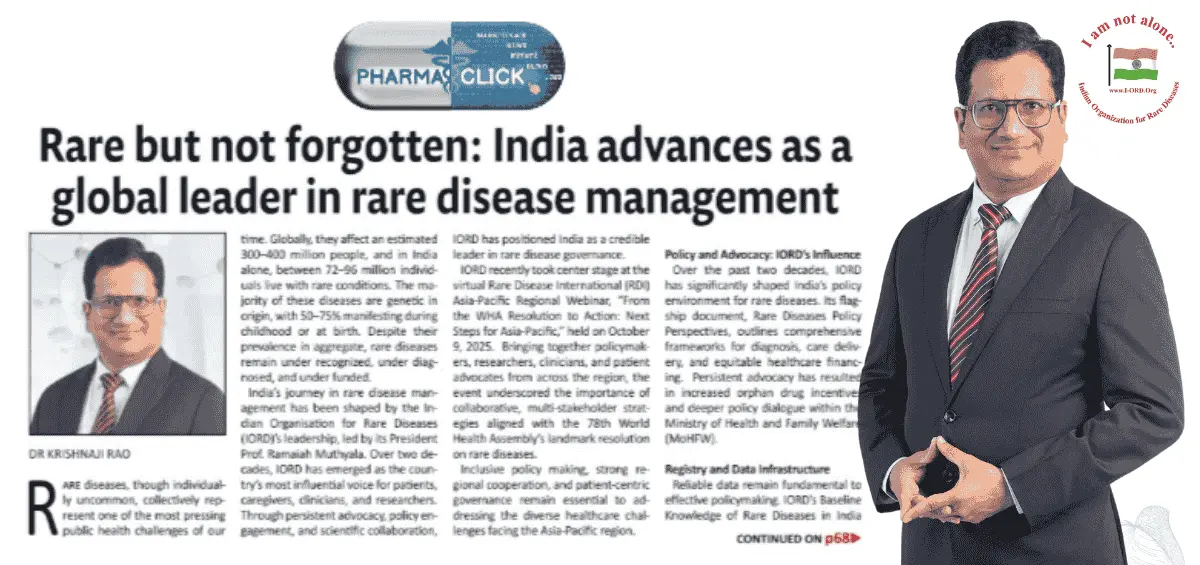
(This article is written by Dr. Krishnaji Rao, IORD Secretary, and first appeared in Pharmaclick magazine on pages 67, 68, and 69. The original article can be accessed here)
The Indian Organisation for Rare Diseases (IORD) is a pivotal force championing rare disease—conditions that, while individually uncommon, collectively affect millions. Founded in 2005, IORD represents a broad coalition of patients, caregivers, clinicians, and advocates committed to ensuring timely diagnosis, treatment, and ongoing support for those living with rare diseases in India.
IORD’s leadership, led by its Founder, CEO, and President Prof Ramaiah Muthyala, recently took center stage at the virtual Rare Disease International (RDI) Asia-Pacific Regional Webinar, “From the WHA Resolution to Action: Next Steps for Asia-Pacific,” held on October 9, 2025. Bringing together policymakers, researchers, clinicians, and patient advocates from across the region, the event underscored the importance of collaborative, multi-stakeholder strategies aligned with the 78th World Health Assembly’s landmark resolution on rare diseases.
Inclusive policymaking, strong regional cooperation, and patient-centric governance remain essential to addressing the diverse healthcare challenges facing the Asia-Pacific region.
Policy and Advocacy: IORD’s Influence
Over the past two decades, IORD has significantly shaped India’s policy environment for rare diseases. Its flagship document, Rare Diseases Policy Perspectives, outlines comprehensive frameworks for diagnosis, care delivery, and equitable healthcare financing. Persistent advocacy has resulted in increased orphan drug incentives and deeper policy dialogue within the Ministry of Health and Family Welfare (MoHFW).
Registry and Data Infrastructure
Reliable data remain fundamental to effective policymaking. IORD’s Baseline Knowledge of Rare Diseases in India survey revealed that 43% of healthcare professionals had never encountered a rare disease patient, underscoring significant data gaps. Consequently, IORD advocates establishing a national rare disease registry prioritizing data interoperability, patient-reported outcomes, and longitudinal tracking to support both policy decisions and research.
Building Scientific Capacity and Innovation
IORD’s white paper, A Journey Together: Rare Diseases & Orphan Products in India, presents a detailed roadmap to boost research and development, diagnostics, and affordable therapeutic innovation. Collaborations among academic institutions, biotech startups, and pharmaceutical companies aim to accelerate genomic research aligned with global standards but tailored to India’s specific needs.
Office of Orphan Drugs: A Critical Missing Piece
Closing the gap between available treatment options and the needs of patients living with rare diseases requires navigating issues and obstacles typically not met in the current setting. Small patient numbers, incomplete understanding of disease pathology and natural history, and the lack of established clinical endpoints make it a challenging endeavor.
Due to the large number of rare diseases, many academics and industry professionals are unaware of the problems associated with them, as the information is scattered and buried among the vast amount of data available for common diseases. Therefore, finding the information is quite challenging. It is an identity crisis that lacks recognition, not a lack of information.
To address this issue, IORD leadership led by its Founder, CEO and president Dr Ramaiah Muthyala had suggested establishing a dedicated Office for Rare Diseases and Orphan Products, which received favourable comments from policymakers, industry personnel, and other stakeholders.
Improving Fund Access for Rare Diseases
The recent constitution of ₹974 crore under the National Fund for Rare Diseases (2024–26)—as mandated by the Delhi High Court—and the enhanced treatment grant of ₹50 lakh for all rare disease categories by the central government mark significant progress and renewed hope for many families.
This progress can only lead to real impact if the existing gaps in access, transparency, and implementation are addressed. However, key problems persist:
- Lack of transparency in fund disbursal: There is no real-time public data on the waiting list of patients under the RAN scheme, making it impossible for families and stakeholders to track fund allocation or delays.
- No guaranteed access for patients whose diseases are already listed: Although 64 diseases are included under the National Policy for Rare Diseases (NPRD), many families continue to report delays, denials, or an inability to access the financial support they are eligible for.
- Exclusion of patients with unlisted rare diseases: Individuals whose conditions are not part of the NPRD are automatically ineligible, leaving them without diagnostic assistance, temporary support, or any structured path toward inclusion.
To address these issues, the 12 Centres of Excellence must ensure transparent, patient-friendly, and efficient fund disbursal with clear timelines. Public reporting of the number of registered patients, status of fund disbursal, and daily progress updates on MoHFW and CoE websites would build trust, strengthen accountability, and allow real-time monitoring.
Additionally, patients with conditions not yet listed under the NPRD should receive diagnostic aid, interim funding options, or a defined mechanism for future inclusion, ensuring that no rare disease patient is left behind.
Other key recommendations include:
• Strengthening the existing national rare disease registry by incorporating standardized data elements and integrating patient networks, as the current ICMR National Registry for Rare and other Inherited Disorders (NRROID) lacks detailed and comprehensive information on many rare diseases.
• Strengthening the existing rare disease crowdfunding portal—created to pool government, CSR, and philanthropic contributions—which has so far failed to gain traction. The government’s rare disease crowdfunding portal—intended to pool government, CSR, and philanthropic contributions—has not been effective, having raised only ₹3,91,589 so far. This highlights the need to strengthen the platform and adopt a more structured, proactive fundraising strategy to ensure patients receive meaningful support.
• Introducing incentives for domestic orphan drug manufacturing under a production-linked incentive model.
• Expanding capacity-building initiatives and establishing more CoEs.
• Implementing transparent, patient-inclusive governance across all rare disease programs.
Diagnosis of Rare Diseases
Timely and accurate diagnosis remains one of the greatest challenges in rare disease management, often determining the course of patient outcomes. In India, diagnostic delays can stretch over several years due to limited clinical awareness, insufficient specialized laboratories, and restricted access to genomic testing.
Currently, India has only 12 Centres of Excellence (CoEs) for rare diseases across 28 states and 8 union territories, with two located in Delhi. The most recent addition, AIIMS Bhopal, highlights both progress and the pressing need for broader coverage. The Indian Organisation for Rare Diseases (IORD) has been actively advocating for the expansion of CoEs—at least one per state—to ensure equitable access to timely diagnosis. For example, during the World Rare Disease Day 2025 event in Vijayawada, IORD emphasized the need for a CoE in Andhra Pradesh.
Given that an estimated 72–96 million people in India live with rare diseases—and that 50–75% of these conditions manifest during childhood or at birth—early screening and intervention become essential. The Rashtriya Bal Swasthya Karyakram (RBSK), launched in 2013 under the National Health Mission (NHM), provides a vital framework for identifying congenital and developmental disorders among children through its focus on the 4Ds—Defects at birth, Diseases, Deficiencies, and Developmental delays including Disabilities.
However, RBSK currently covers only about 30 conditions, leaving out most rare and genetic disorders that present in early life. Expanding the program’s disease list and establishing stronger referral linkages between District Early Intervention Centers (DEICs), Centres of Excellence (CoEs), and NIDAN Kendras can transform RBSK into an effective early detection and referral system. Integrating teleconsultation mechanisms within the program would further enable local healthcare providers to access expert guidance from tertiary centers, ensuring timely diagnosis and coordinated care.
To improve diagnostic precision across all levels, IORD continues to advocate for integrating genomic sequencing, bioinformatics tools, and multidisciplinary diagnostic centers into tertiary healthcare systems. Establishing a unified, interoperable national database that links clinical findings with molecular data will enhance accuracy, enable real-time data sharing across institutions, and drive both clinical and research advancements nationwide.
Prevention of Rare Diseases
Preventing rare diseases requires a proactive and informed public health strategy that combines genetic counselling, early screening, and widespread education. Since a majority of rare diseases are genetic in origin, prevention efforts must start well before conception.
Pre-marital counselling by trained geneticists and counsellors—offered through Centres of Excellence (CoEs) or regional medical institutions—can help identify hereditary risks and guide couples toward informed reproductive choices. Integrating targeted preconception and prenatal genetic screening into existing national health programs, particularly for families with a known history of genetic disorders or high-risk tribal populations, can significantly reduce the incidence of preventable monogenic rare disorders through early detection and intervention.
IORD envisions national-level genetic literacy campaigns to improve understanding among both healthcare professionals and the public. Establishing regional genetic counselling units linked with public hospitals and CoEs will ensure that preventive services are not limited to urban centres but reach families across India.
By embedding these preventive measures into the broader rare disease policy framework, India can reduce the burden of preventable genetic disorders and move closer to its vision of equitable, family-centered rare disease care.
Vision for Global Leadership
With evidence-based advocacy and a patient-centric philosophy, IORD positions India as a potential global pioneer in rare disease management. By leveraging registry data, local R&D capabilities, and cost-effective innovations, India aims to develop scalable, affordable care models that serve as benchmarks for other nations confronting similar challenges.