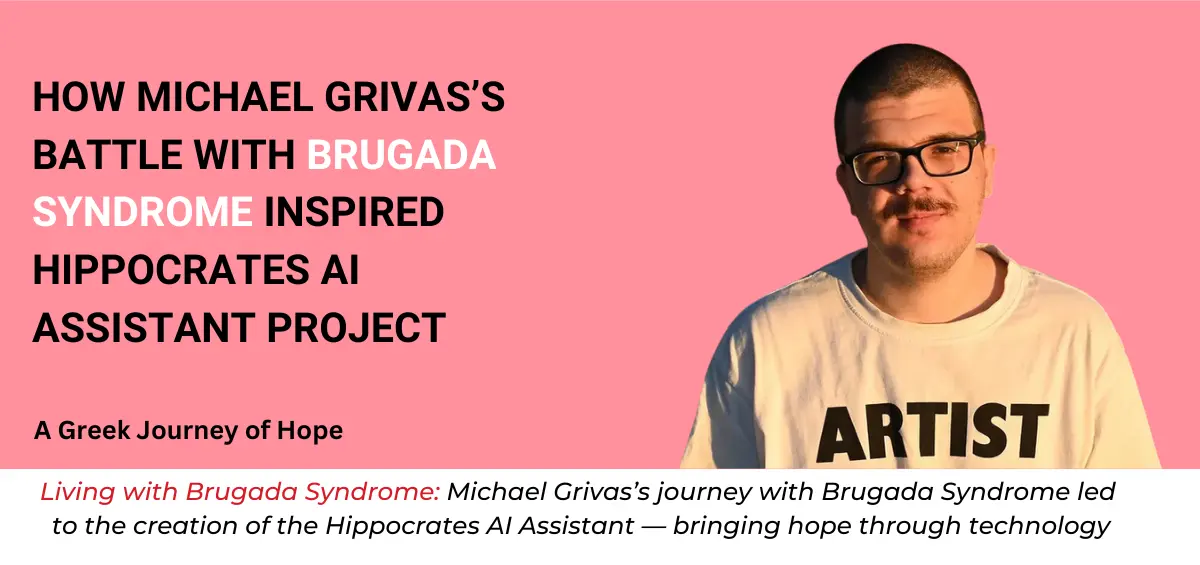
Diagnosed with Brugada Syndrome at 27, Michael Grivas from Greece turned his personal health struggle into a mission to help others. His experience inspired the creation of the Hippocrates AI Assistant, an AI-driven tool designed to help doctors detect cardiac conditions early and save lives. In this touching first-hand account, Michalis shares his personal journey living with Brugada Syndrome
My name is Michael Grivas and I want to share my story.
I am 27 years old and I come from Greece. Four years ago, my life changed suddenly. When I learned that I have Brugada Syndrome, I felt like the ground was slipping away beneath my feet.
In 2021, I was hospitalized with acute myocarditis and a type 1 Brugada ECG, during a period that was already very difficult for everyone due to COVID-19. I could not see my parents and friends regularly. I was alone in the hospital for three consecutive months, and the anxiety was enormous, both for me and for my parents.
Brugada is insidious, especially for someone my age. It tends to “hide” in the ECG. Many times it appears normal, but it is not. And with the myocarditis I had at the same time, it was even more difficult to reach the correct diagnosis. The doctors did not know whether the findings were due to Brugada or myocarditis.
After my hospitalization and following a fainting episode, it was finally decided that I should be implanted with an ICD (Implantable Cardioverter Defibrillator). When it happened, I felt like life was given back to me. Honestly, it was a huge weight lifted off my shoulders.
Brugada is not just a medical term. It is fear, uncertainty, and limitations. I learned to find strength in small moments: in a conversation with friends, in a look that calms me, in a smile that brightens my day. My family and friends stood like lighthouses. Without them, I don’t know what would have happened.
In Greece, for an ICD to be approved, you must have already suffered a cardiac arrest. This leaves many people exposed. Some show warning signs but are not saved in time. Others who suffered an episode did not survive.
And that is exactly where the idea for the Hippocrates AI Assistant Project was born an artificial intelligence platform that can provide accurate and timely diagnosis of cardiac conditions. I want to help doctors make the right decisions quickly, save lives, and reduce errors. The most important thing for me is that I never want anyone else to go through what I went through.
When everything seems lost, there is always a road ahead. Hope can be born out of fear. Strength can be born out of difficulties. Every day is an opportunity to continue, to dream, and to move forward.
Do not let hardships break you. Life always gives a second chance, and it is worth seizing.
The Birth of the Hippocrates AI Assistant: Using Technology to Save Lives
The Hippocrates AI Assistant is an innovative artificial intelligence platform currently in pre-MVP development stage, where the algorithms are being adjusted and tested to ensure accuracy and reliability of results.
The platform is aimed at cardiologists, medical residents, hospitals, and diagnostic centers, enhancing their ability to recognize dangerous cardiac conditions early.
Until now, I have been running the project alone, except for a few people who helped for a short period. Now I am looking for people who want to support this effort and help build strong teams, so that the project can reach the global market. My goal is to expand the system to a global healthcare level, providing timely, fast, and accurate diagnosis for Brugada Syndrome.
The project started with Brugada Syndrome because of my personal story, but I want to expand it to other cardiac conditions over time, so that more patients can benefit.
In the future, it will be offered through a subscription model for hospitals and private doctors.
Understanding Brugada Syndrome: Symptoms, Diagnosis & Challenges
Brugada Syndrome is a genetic heart condition that affects the function of the heart’s ion channels, causing arrhythmias, fainting episodes, palpitations, or even sudden cardiac death, usually at rest or during sleep. There are three types of ECG patterns (Type 1, 2, and 3), with Type 1 being the most characteristic and dangerous.
Diagnostic Challenges
Brugada can “hide” in the ECG and may not appear on every test. In some cases, provocation tests or continuous ECG monitoring are required to confirm the diagnosis. Timely and accurate interpretation requires experience and specialized tools, which is where the Hippocrates AI Assistant aims to help.
Brugada Syndrome Support and Global Awareness: How You Can Help
Currently, there are few organized support groups for Brugada Syndrome patients, both in Greece and internationally. However, there are online communities and information pages where patients and relatives can share experiences and information.
Personally, I want to help create a patient support group, so that people diagnosed for the first time do not feel alone. I would be glad to hear from people who want to share their experiences as Brugada Syndrome patients or those who want to support the awareness effort and help build teams for the project so it can reach the global market.
Anyone interested in learning more or participating can contact me at:
hippocratesaiassistant@outlook.com
Do not let hardships break you. Life always gives a second chance, and it is worth seizing. — Michael Grivas