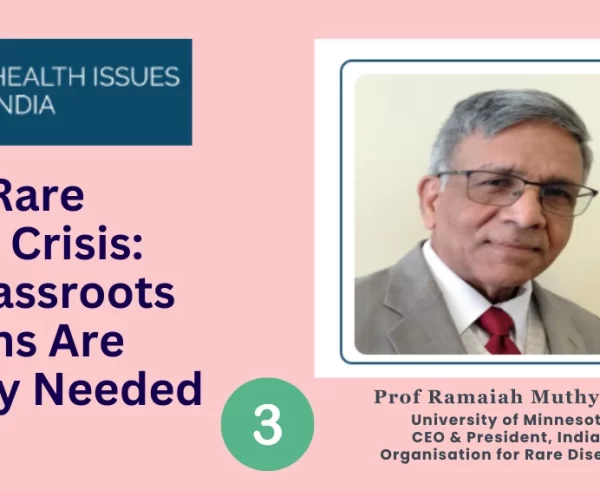

This is a translated excerpt from Prime9 News panel discussion on rare diseases, featuring experts Dr. Amaresh Rao, Dr. Krishnaji Rao Muthyala, and Professor Ramaiah Muthyala. The discussion explored the challenges of diagnosing rare conditions, gaps in awareness, and the urgent need for policy action to address these life-threatening illnesses, which remain largely undiagnosed despite scientific advances. Check the full interview here.
Namaste, welcome to our special debate.
Lately, we’ve been hearing sudden and shocking news: some unknown illness strikes, and in the prime of their lives, people are gone. We say “Oh, such a pity” — but we often have no idea what disease it was, how it came, or where it was hiding all this time. All we know is that it is life-taking.
Even with so much scientific progress, why do some diseases remain mysterious, beyond even the understanding of scientists?
When will we truly know the identity and origin of these elusive diseases? How many such conditions exist?
With us are:
Dr. Amaresh Rao, CTVS surgeon and Head of Department at NIMS Hospital, Hyderabad; Managing Committee member, IORD.
Dr. Krishnaji Rao Muthyala, pharma scientist, Secretary of IORD
Joining via Zoom — Professor Ramaiah Muthyala, CEO and President of IORD and Professor at the University of Minnesota, USA.
Hello, sir, welcome to our show.
Dr. Amaresh, could you first share your opinion — what exactly are “rare diseases” that even science can’t tackle? Why do they occur?
Defining Rare Diseases
[Dr. Amaresh] We call them “rare diseases,” but in reality, they’re not always so rare. With today’s medical advances and diagnostic technologies, we can rule out many other diseases and then identify that a case might be due to a rare condition. There’s more awareness now, thanks to people like Professor Ramaiah, who disseminates information widely.
Specialised centres of excellence exist, and patients can access them for diagnosis. Government policies and funded programs are helping to bring these cases to light. Considering India’s population size, even “rare” diseases affect a significant chunk of people.
[Anchor] But how do we identify them now? Even with today’s knowledge, diagnosing rare diseases remains a challenging task. For common conditions like diabetes, hypertension, or even cancer, awareness programs help, but how does one detect a rare disease?
Challenges in Identification
About 70–80% of rare diseases are congenital, and most of these show up in children. Government policy now emphasises institutional births, and school health screening programs have undergone improvements. Initiatives like Ayushman Bharat and Aarogyasri give people access to healthcare, which brings more cases to light.
Typical signs in children may be epilepsy or heart conditions. Increased awareness and improved diagnostics mean more cases are detected. Rare diseases are being recognised more often — they’re “rare” in name, but relatively common.
Sudden deaths also increase public awareness — for example, recently, a 29-year-old badminton player collapsed and died. Such incidents prompt more people to undergo screening, and doctors are also screening their patients more thoroughly.
[Anchor] We’ll come back to cardiac cases later — but first, Dr. Krishnaji Rao, before we discuss policy, could you tell us why these rare cases are increasing and why awareness is still lacking?
Policy and Industry Collaboration
[Dr. Krishnaji Rao] In Telugu, we refer to them as “arudaina jabbulu” — rare diseases. However, what constitutes “rare” varies from country to country. Advanced nations, such as the USA, Japan, and those in Europe, have established definitions – for example, in the USA, any disease affecting fewer than 200,000 people is considered rare.
In India, we lack a clear definition — this was one of the first challenges IORD took on. Our journey began in 2005, but by 2014, we had focused seriously on rare diseases. Developing a drug for such a disease is referred to as creating an “orphan drug.”
To achieve this, we need integration between science and technology, the health ministry, and education — and we must also involve the commerce ministry, as pharmaceutical manufacturing is a key component of this effort.
In 2014, we approached Dr P.V. Appaji, then Director General of Pharmexcil (the Pharmaceutical Export Council of India, set up by the Ministry of Commerce & Industry). They recognised the complexity and supported the idea. With backing from officials such as Rajeev Kher and Sudhanshu Pandey from the Commerce Ministry, we began exploring how India could manufacture and possibly export orphan drugs.
We also needed public awareness. We approached former President Dr. A.P.J. Abdul Kalam, who spent over two and a half hours with our team, planting the seed of awareness about rare diseases in India.
IORD is not only an Indian organisation; we have global ties and learn from the policies of other countries. Our goal was to establish a baseline definition for India, enabling companies to receive recognition for their efforts in developing orphan drugs.
We worked strategically with the Prime Minister’s Office, the health ministry, and the commerce ministry. Eventually, chapters on rare diseases and orphan drugs were added to India’s Drugs & Cosmetics Act, which gave companies a policy framework.
We also advocated for product-linked incentives for pharmaceutical companies developing orphan drugs in India.
However, awareness must also reach frontline staff, including nurses and community workers. We’ve conducted training and webinars for them. In Telangana, for example, we’ve started movements with ASHA workers to reach rural areas.
Still, challenges remain: delays in diagnosis lead to children not surviving past early birthdays or to conditions progressing for decades.
NIMS has an excellent capacity, with knowledge comparable to the best facilities in the world — but we must focus on all segments of the chain to continue this journey. Even corporate hospital doctors lack this awareness. Some of the doctors said that they had never seen a single case in their 30-year lifetime when we conducted a baseline survey. The medical curriculum needs to be updated.
[Anchor] For a more complete definition, let’s hear from Professor Ramaiah.
Global Context and Definitions – Importance of Registries
Professor Ramaiah: A “rare” disease, for the individual suffering from it, is devastating. However, policymakers require a formal definition to develop effective policies.
Unfortunately, there’s no universal definition:
In the USA, fewer than 200,000 cases
In Japan, fewer than 50,000
In India, even agencies like ICMR and CDSCO have differing definitions.
Given India’s vast population compared to smaller countries, we cannot simply copy their numbers — we must have our own.
The ICMR has attempted to build disease registries but hasn’t succeeded fully. One suggestion we’ve made is to include a questionnaire about rare diseases in the national census, allowing us to track their prevalence. However, we could not succeed.
We are less concerned about the disease name itself than about whether it is not common. If a doctor cannot identify it as a common illness, such as TB, malaria, dengue, or diabetes, we suggest considering it a rare condition. This would enable the counting of patients and help inform policy.
Telangana survey
We are currently conducting a sample survey in Telangana using ASHA workers. As you are aware, ASHA workers have a deeper understanding of the health situation in villages than anyone else. Around 60% of our population still lives in rural areas. Many tertiary-level hospitals maintain registries of certain rare diseases. If we can count cases in the villages through ASHA workers and then combine that with the data from tertiary hospitals, we should be able to get at least a rough idea—if not an exact figure—of the prevalence.
That is one of our proposals. Currently, in Telangana, we are surveying in Khammam district, specifically covering one mandal with a population of approximately 160,000 people, as a sample. We hope to have this information in a couple of months. If the results are reasonably accurate or acceptable, we can extend the survey to larger areas. Eventually—if not immediately—we should be able to arrive at a workable definition for rare diseases. That’s what we are attempting.
Anchor to Dr. Amaresh: Alright, Dr. Amaresh sir, as we discussed earlier, in the case of cardiac diseases, how many are rare?
Whether it is a common or rare condition, first we need to know the extent of the problem—how many resources we need to commit. This is a significant challenge. As Professor Ramaiah mentioned earlier, to understand the extent of the problem, we need incidence data—how many people in a lakh have the disease.
That is why Professor Ramaiah is doing this survey in Khammam district. If registries existed, we would know the exact extent. Unfortunately, we currently do not have such registries. Without registries, we observe that the incidence appears to be higher in some institutions or areas and lower in others—purely due to differences in diagnostic capacity. In rural primary health centres or hospitals without diagnostic facilities, obviously, fewer cases are “seen” because they can’t be diagnosed.
At NIMS, we have advanced diagnostics and government-funded DNA labs, along with experienced teams—so naturally, we detect more cases. We have very active transplant programmes—both pediatric heart surgeries and lung transplants—many done completely free to patients under government health schemes. So, many patients come to us for diagnosis.
If we examine 50 patients for potential transplant, only about 5 to 10 turn out to be fit for it. However, among those, about 20–40%—so roughly one-third—are what we call “rare conditions” or rare diseases. This is true for both end-stage heart failure and end-stage lung failure, especially in younger patients.
In children, conditions such as holes in the heart and valve defects; in adults and adolescents, rare vascular blockages or aneurysms—once these conditions are investigated in detail, they come to light. Ten years ago, these were seldom seen; now, based on the proposed definitions, the incidence has increased.
By some definitions, even diseases like leprosy or polio—now nearly eradicated—are considered rare. But in certain regions, genetic disorders like sickle cell anaemia or thalassemia are common, while absent elsewhere. We also see hydatid disease (water-filled cysts in lungs or abdomen) more in areas like Vidarbha or rural Telangana, but examiners from North India are surprised to see it—it’s unfamiliar to them. So, “rare” can vary by region, area, and diagnostic capacity. At advanced centres, it’s common to see such cases.
Diagnosis of Rare Disease
[Anchor] How long does it take to diagnose—months or years?
[Dr. Amaresh – on diagnosis delays and awareness]
Yes, diagnosis takes time. From the first point of care, patients often don’t receive satisfactory treatment, so they move from one hospital to another—this is sometimes referred to as “doctor shopping.” However, in such cases, they have no choice, as they still have no diagnosis or relief.
When we surveyed healthcare workers, awareness about rare diseases was negligible—not just among doctors, but also among nurses. Rare diseases are not covered in the standard medical curriculum; doctors learn only about the top five common conditions—not about the 15th rare one.
Government policies now encourage centres of excellence and disease-specific centres, especially with a genetic component—so facilities like the Centre for DNA Fingerprinting, CCMB, and the genetics department at NIMS are playing a key role. This enables diagnosis, as well as the conduct of clinical trials.
When it comes to orphan drugs—medicines for rare diseases—the government provides subsidies and incentives for research, which encourages companies to get involved. At places like NIMS, there’s a higher proportion of patients with rare diseases, so research into conditions like muscular dystrophies is actively pursued. If policy is refined to not only support trials but also subsidise treatment for low-income patients, it would be beneficial. The government has even announced grants of around ₹50 lakhs per rare-disease case.
Diagnosis Challenges
[Anchor to Prof. Ramaiah – on global context]
Sir, in developed countries, diagnosis rates are much higher than in India. Even so, it still takes years to diagnose a rare disease, with patients visiting multiple specialists and sometimes getting misdiagnosed. Why does diagnosis still take so long despite modern technology? And in the meantime, the patient’s condition worsens—what should be done?
One hard truth: for many rare diseases, the endpoint is death.
At best, we can manage or improve the quality of life—we cannot truly cure most of them under current technology. Perhaps in a handful of cases, gene therapy has been successful, but such solutions are far away—possibly generations away. In 40 years, only about 5% of the nearly 7,000 known rare diseases have any drug at all—and those are treatments, not cures.
It has taken decades to build even basic diagnostic capacity. Over the last 20 years, we’ve developed awareness not only among patients, but also among medical schools, doctors, and pharmaceutical companies—but the journey is still ongoing. Diagnosis alone is not enough—once diagnosed, what next? Even if there’s no cure, early detection allows governments, doctors, and families to prepare and manage the patient more effectively. Newborn screening is one such preventive measure.
For example, sickle cell disease—a painful and potentially fatal blood disorder—can be prevented through genetic screening. When Mr. Modi was the Chief Minister of Gujarat, he started a programme that tested adolescents before puberty. People were classified with red cards (both defective genes), yellow cards (one defective gene), or white cards (no defective gene). Families were educated that if a carrier marries another carrier, the disease continues, but if not, it can disappear in a few generations. Similar logic applies to over 3,000 other monogenic disorders.
Current Policy Initiatives
[Dr. Amaresh – on why rare diseases matter] Some ask us: why focus on rare diseases when each transplant takes so many resources—money, personnel, hospital beds—when the same could do ten bypass surgeries? The answer is that tackling a complex, rare-disease case raises the expertise and systems for all other cases as well. For a transplant to succeed, the risk of infection must be zero—if that level of care is achieved, it benefits all patients.
Similarly, diagnosing rare diseases requires detecting hundreds of common ones as well—that strengthens the whole healthcare ecosystem. In the past, we overcame killers like smallpox, polio, TB, cholera, and respiratory infections through coordinated prevention, awareness, and treatment—raising average lifespan from 33 years at Independence to 76 now. Focusing on rare diseases will elevate the overall system in the same way. And where there’s no treatment yet, early detection and prevention are the most important goals.
Why Early Detection Matters
[Dr Krishnaji Rao – On policy for prevention]
Before we reach the policy stage, a prevention policy must be in place. For example, when two people plan to get married, they often match horoscopes. Along with horoscopes, there should also be a mandatory gene mapping check. The Maharashtra government has already made this a mandatory requirement. Just as you need a marriage registration certificate, you would also need a gene mapping certificate.
Prevention Through Genetic Screening
[Example – Haemophilia case]
Let me share a case from my own experience, though I cannot explain it as medically as Dr. Amaresh can. Haemophilia, for instance, affects men more than women. If testing is done within the first three months of pregnancy, this can be detected. Although by law it is a crime to disclose the sex of the baby, there are certain situations where such tests can help us prevent a medical issue from being passed on.
Carriers—whether male or female—can be informed early that if they have specific defective genes, the next generation may face the same health problem. This allows families to take preventive action.
Pharma and Patient Networks
Coming from the pharmaceutical side, I can say there are now some medicines for conditions like sickle cell anaemia and haemophilia. If a pharma company decides to make one of these medicines, it is often because necessity is the mother of invention.
COVID-19 was a perfect example that showcased India’s technological strength in both the medical and pharma sectors. This proves that just as we could mobilise for COVID, we can also tackle rare diseases. The medical expertise and treatment methods exist; what we need is the right policy framework. And for policy, we need numbers—clear data on the number of patients.
For instance, sickle cell anaemia patients have an association; haemophilia patients have a society. These patient groups maintain numbers, and that’s why they get recognised, included, and approached for treatment initiatives. When you can say, “We have X number of patients with this disease, we can make the medicine in India—so why not give it to them?” things start moving.
Where patient numbers exist, treatment delivery is easier because pharma companies see the demand. In India, pharmaceutical infrastructure, medical genetics departments, and DNA diagnostic centres, such as the CCMB, already exist. Doctors are slowly becoming more familiar with diagnosing such cases. But the missing link is: how does a medicine made by the pharma industry reach the right patient?
Pharma companies plan the entire product lifecycle—but they need a list of patients or locations to deliver efficiently. The cycle is as follows: a problem leads to an invention, which matures into an innovation, and then gets commercialised. Then comes manufacturing, followed by dosage forms such as tablets, and then distribution. But if you do not know where the patients are, even after making the drug, delivering it becomes difficult.
For the industry, producing for a small patient group is a significant question—are their capacities being utilised for only two or ten people? Regulations, manufacturing capacity, and economics all play a role. Yet, if even a few lives can be saved, shouldn’t we still do it? Building strong patient networks is critical here.
Corporate Governance and Patient Reach
Earlier, pharma companies focused purely on profit; now, they must also answer to stakeholders such as patient groups. In this era of transparency, companies must ensure their operations also directly reach patients in need. Places where bottlenecks exist must be identified and fixed—especially in patient networking. Interviews like this increase awareness and make patients realise “there is someone out there discussing our needs.”
At IORD, if a patient calls—even at midnight—team members respond and guide them to the nearest recognised centre. If they are in Delhi, we direct them to AIIMS Delhi; if in Hyderabad, to NIMS Centre for Excellence. The government has already identified such Centres of Excellence. In Andhra Pradesh, too, after high-level meetings with ministers, efforts are underway to set up similar centres so rare-disease patients there can also get care.
Everything links back to policy and to the ultimate goal: reaching the patient. That’s the endpoint we must focus on.
Ensuring Medicine Access
Prof Ramaiah Muthyala says: Sometimes we don’t even know where all the patients are, even though we know they exist. When medicine supplies are limited, pharmacies typically don’t maintain stock. That’s why we suggested that government medical shops, ie Janaushadhi. So patients know at least where they can get them.
Dr. Kalam’s Vision
[Dr. APJ Abdul Kalam’s dream] Let me say this with emotion—Dr. Kalam had a great interest in rare diseases. In 2015, I had a half-hour appointment with him, but we ended up talking for an hour and a half. His biographer once told me Dr. Kalam had six unfinished projects—rare diseases was one of them. Unfortunately, he passed away just three months after we spoke. It was a massive loss for us and the country.
Although progress has been made in the last 10 years since he spoke to us, it is only a beginning. His vision was that patients with rare diseases should have the same opportunities as those with common diseases. That means awareness building, policy creation, and medicine development—none of these alone is enough; all must happen together. It will take time, but it will not stop. IORD’s entire leadership believes that the mission will continue indefinitely until the goal is achieved.
Call to Action
[Dr. Amaresh – concluding suggestions]
No help is too big or too small for this cause—every effort matters. The Orphan Drug Act operates on the logic that if you can incentivise the development of a treatment for a rare disease, researchers will also make advancements that benefit common diseases. Any benefit for a rare disease will help common diseases piggyback on it.
The starting point is awareness—not only among the general public but especially among healthcare personnel, paramedical workers, and communities. We must improve diagnostics, particularly in small towns where access remains limited. India’s population is vast—our health delivery infrastructure must reach even the smallest village. We have the technology and systems to locate a patient anywhere within minutes; now, these diagnostic and treatment capabilities must be made available.
Even a sample survey can help us estimate the magnitude of the problem, understand the required budget, and plan effectively. Right now, we’re working mainly with projections; we need hard data.
This was Dr. Kalam’s dream project, and we hope it comes true. We also hope more people and authorities join this mission. Thank you, Prof. Ramaiah, Dr. Krishnaji Rao and Dr. Amaresh, for participating in this debate and sharing your knowledge. The organisation has been working hard since its inception, with many committed members dedicated to the cause of rare diseases.