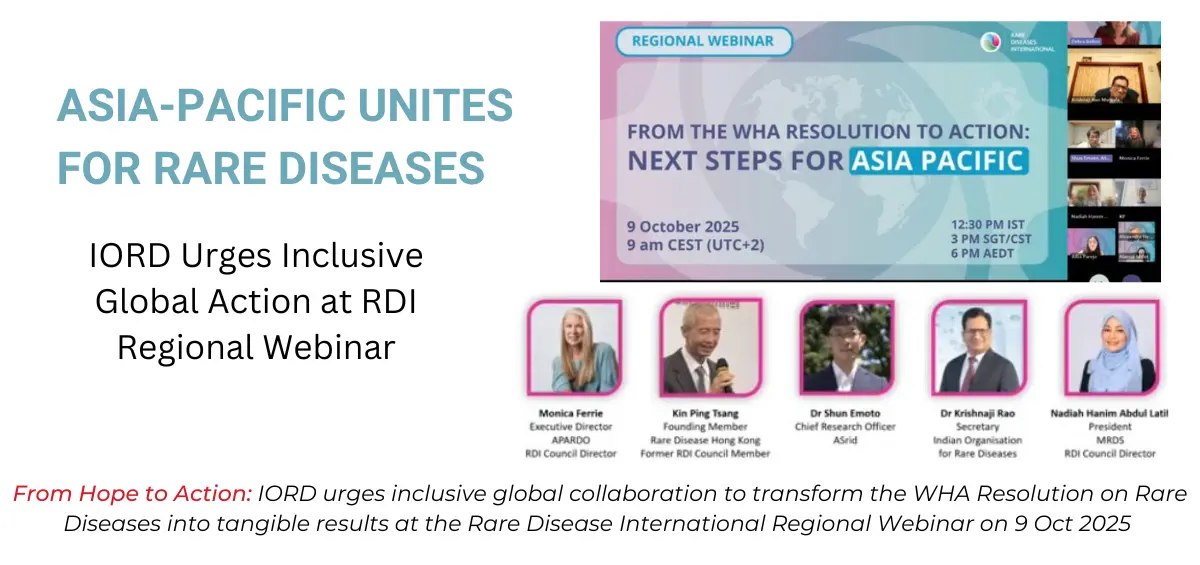
The RDI Regional Webinar on “From the WHA Resolution to Action: Next Steps for Asia Pacific” marked a pivotal moment for regional cooperation on rare diseases.
“Hope” — that was the word chosen by Dr. Krishnaji Rao, Secretary, Indian Organisation for Rare Diseases (IORD), when asked what unites Asia-Pacific’s rare disease community. Speaking at the Rare Disease International (RDI) Regional Webinar, Dr. Rao underscored that hope must now evolve into collective action to ensure that “no country is left behind simply because of capacity or connectivity barriers.”
Held on 9 October 2025, the webinar — “From the WHA Resolution to Action: Next Steps for Asia Pacific” — brought together leading voices from across the region to chart the path forward following the World Health Assembly’s (WHA) landmark Resolution on Rare Diseases.
India Calls for an Inclusive, Representative Framework
Representing India, Dr. Krishnaji Rao highlighted that inclusivity and representation are crucial for making the Global Action Plan on Rare Diseases meaningful and effective. He emphasized that the Asia-Pacific’s diversity—spanning vastly different healthcare systems and economic capacities—demands mechanisms that allow all nations to participate equally in shaping global policy.
He noted that creating multilingual consultations, virtual roundtables, and equitable working groups would ensure that even countries with limited resources can contribute. Dr. Rao stressed that collaboration among national alliances such as IORD and its regional counterparts can amplify the collective voice of patients and policymakers, ensuring that the realities of developing nations are represented in global action plans.
Reinforcing the spirit of unity, he quoted India’s former President Dr. A.P.J. Abdul Kalam, saying, “We may feel alone, but together we can make a lot of difference and influence policy with shared strength and empathy.”
Building a Multi-Stakeholder Ecosystem
Dr. Rao underlined that the challenges of rare diseases cannot be solved by any single group alone. He explained that a multi-stakeholder ecosystem—bringing together patients, researchers, clinicians, policymakers, and industry leaders—is vital to accelerate innovation, expand early diagnosis, and improve access to care.
He pointed out that such collaboration transforms fragmented initiatives into a unified movement that is people-centered, evidence-driven, and globally connected.
Expanding Global Participation
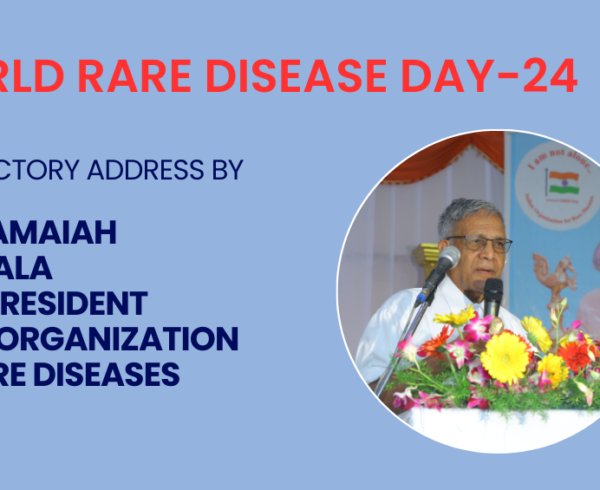
Prof. Ramaiah Muthyala, President and CEO of IORD, observed that fewer than 40 countries have supported the WHA Rare Disease Resolution so far. He emphasized the need for broader international participation, particularly from underrepresented regions such as Latin America, where strong patient networks already exist.
He noted that representation from these regions is as important as that of any other, calling on RDI and member organizations to make concerted efforts to bring them into the global dialogue.
“This collective dialogue reinforces our shared mission — to ensure that people living with rare diseases are recognized, supported, and never left behind.”
— Dr. Ramaiah Muthyala, President & CEO, Indian Organisation for Rare Diseases (IORD)
RDI Sets the Global Context
In her inaugural address, Alexandra Heumber Perry, Chief Executive Officer, Rare Diseases International, welcomed participants from across the Asia-Pacific region and celebrated the historic milestone achieved in May 2025, when the World Health Assembly adopted its first-ever resolution on rare diseases.
She announced that the forthcoming Global Action Plan on Rare Diseases would be developed through strong consultation with civil society, ensuring that patients and advocates are at the heart of shaping its priorities and implementation.
Regional Collaboration and Shared Vision
The webinar convened a distinguished panel of regional representatives, including Monica Ferrie (Executive Director, APARDO & RDI Council Director), Kin Ping Tsang (Founding Member, Rare Disease Hong Kong & former RDI Council Member), Dr. Shun Emoto (Chief Research Officer, ASrid), Nadiah Hanim Abdul Latif (President, MRDS & RDI Council Director), alongside Dr. Krishnaji Rao and Prof. Ramaiah Muthyala from IORD.
Together, the panelists reaffirmed that Asia-Pacific’s collective strength lies in collaboration, where shared experience and mutual advocacy can influence global health policy and drive meaningful change for rare disease communities.
“This collective dialogue reinforces our shared mission — to ensure that people living with rare diseases are recognized, supported, and never left behind.”
— Dr. Ramaiah Muthyala, President & CEO, IORD