IORD Rare Disease Webinar February-2021
- World Rare Disease Day-2025
- World Rare Disease Day-2024
- IORD Rare Disease Webinar February-2021
- World Rare Disease Day-2026
- World Rare Disease Day-2022
- IORD Webinar 2020: Need for Essential Medicines For Rare Diseases
- World Rare Disease Day 2020 Video Gallery
- World Rare Disease Day 2019 Video Gallery
- World Rare Disease Day 2018 Video Gallery
IORD Rare Disease Webinar February-2021
Rare Disease Prevention and Collaborative Action
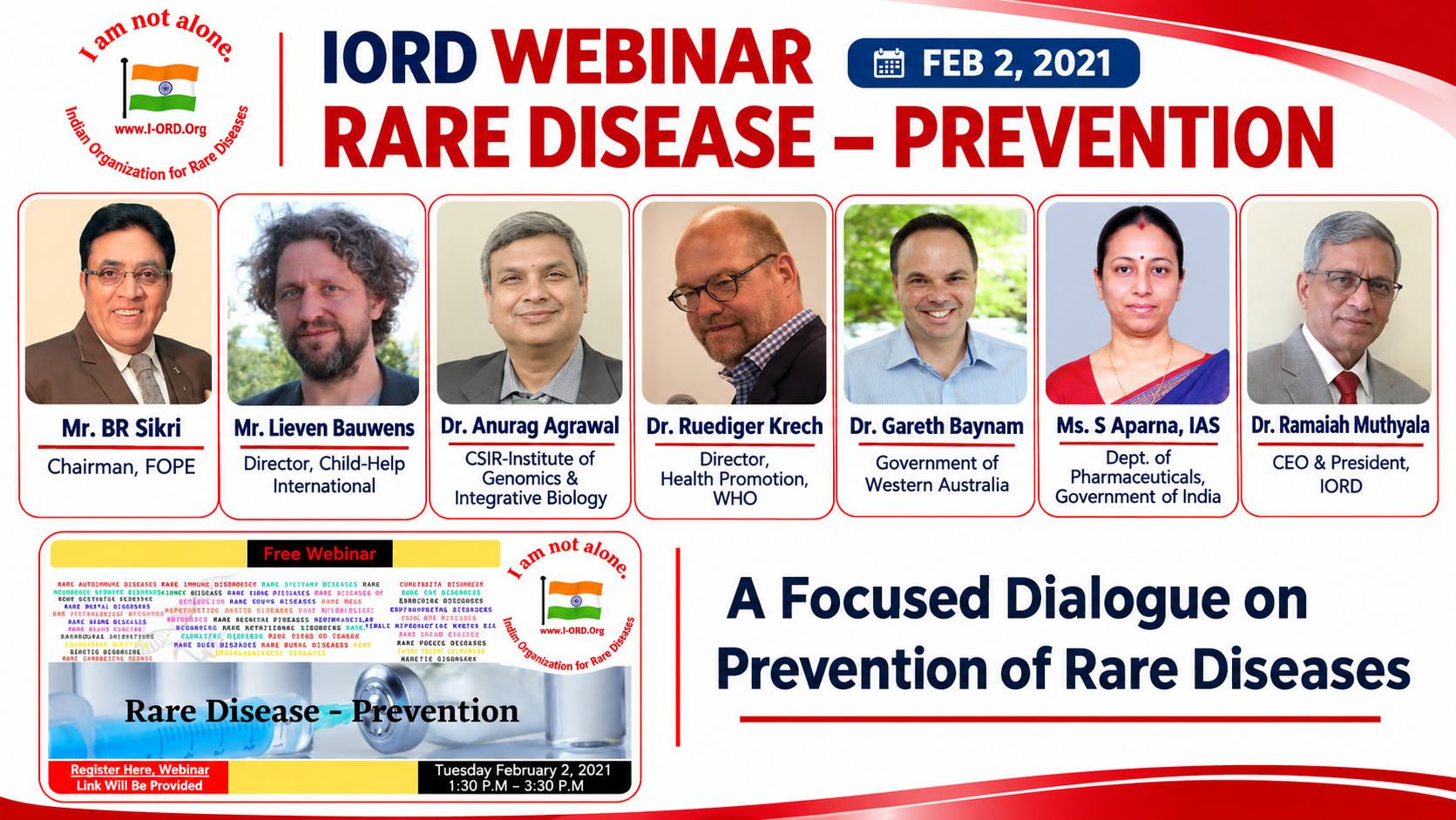
The Indian Organisation for Rare Diseases (IORD), led by President and CEO Dr. Ramaiah Muthyala, organised an international webinar bringing together government representatives, medical experts, researchers, industry leaders and global health organisations to address the challenges faced by people living with rare diseases. The discussions focused on prevention, genetic screening, early diagnosis, affordable treatments, policy reforms and equitable healthcare. Speakers from India and abroad highlighted the importance of government support, scientific innovation and international collaboration in strengthening rare disease care and improving patients’ quality of life. Watch the presentations and key addresses from the webinar below.
World Rare Disease Day 2021: IORD Advocates Prevention and Equitable Healthcare
Dr. Ramaiah Muthyala, President and CEO of IORD, addressed the 2021 Rare Disease Prevention Webinar by highlighting the need to prioritise prevention alongside treatment, with a focus on genetic counselling, early diagnosis and prenatal screening. He also called for equitable healthcare access, affordable orphan drugs, stronger policy support and global collaboration to improve the quality of life of people living with rare diseases.
World Rare Disease Day 2021: Ms. S. Aparna Highlights Government Initiatives for Rare Diseases
Ms. S. Aparna, IAS, Secretary, Department of Pharmaceuticals, Government of India, highlighted the challenges of rare disease awareness, diagnosis and access to affordable treatment during the IORD webinar. She outlined government initiatives supporting orphan drug development, clinical trials and preventive measures, reaffirming the government’s commitment to improving access, affordability and collaboration with patient organisations.
World Rare Disease Day 2021: Dr. Anurag Agrawal Highlights Genomics for Rare Disease Prevention
Dr. Anurag Agrawal, Director of CSIR-IGIB, highlighted India’s genetic diversity and the importance of genomic research, community-based screening and genetic testing in identifying and preventing rare diseases. He emphasised whole-genome sequencing, bioinformatics and initiatives such as IndiGen and Gene Card to advance early diagnosis, preventive strategies and personalised healthcare.
World Rare Disease Day 2021: Lieven Bauwens Advocates Prevention of Birth Defects Through Folic Acid Fortification
Mr. Lieven Bauwens, Director of Child-Help International, highlighted the challenges faced by individuals with spina bifida and hydrocephalus, emphasising the importance of lifelong care and early prevention. He urged the Indian government to strengthen food fortification with folic acid to reduce neural tube defects, citing evidence that folic acid-fortified staple foods can significantly lower the incidence of these birth defects.
World Rare Disease Day 2021: Dr. Gareth Baynam Highlights Four Pillars of Rare Disease Prevention
Dr. Gareth Baynam, representing the Government of Western Australia, outlined four pillars of prevention: primary, secondary, tertiary and quaternary, highlighting the role of screening, early diagnosis and coordinated care in reducing the burden of rare diseases. He also emphasised integrating congenital disease prevention into national health programmes, introducing rare disease coding systems and leveraging genomic research and technology to improve diagnosis and patient care in India.
World Rare Disease Day 2021: Dr. Rüdiger Krech Calls for Global Cooperation and Innovation in Rare Diseases
Dr. Rüdiger Krech, Director of Health Promotion at WHO, Geneva, highlighted the importance of pooling resources, international cooperation and innovation to address the challenges of rare diseases. He emphasised equitable healthcare, sustainable funding, multidisciplinary expertise and collaboration in research and drug development, reaffirming WHO’s support for India’s efforts to strengthen rare disease care.
World Rare Disease Day 2021: BR Sikri Calls for Equal Treatment and Stronger Collaboration for Rare Disease Patients
Mr. BR Sikri, Chairman of FOPE, appreciated IORD’s efforts in bringing together national and international experts to address rare disease challenges and advocate equal healthcare rights for patients. He emphasised stronger collaboration between government, pharmaceutical associations, regulators and patient organisations to improve access to treatment and enhance the quality of life of people living with rare diseases.